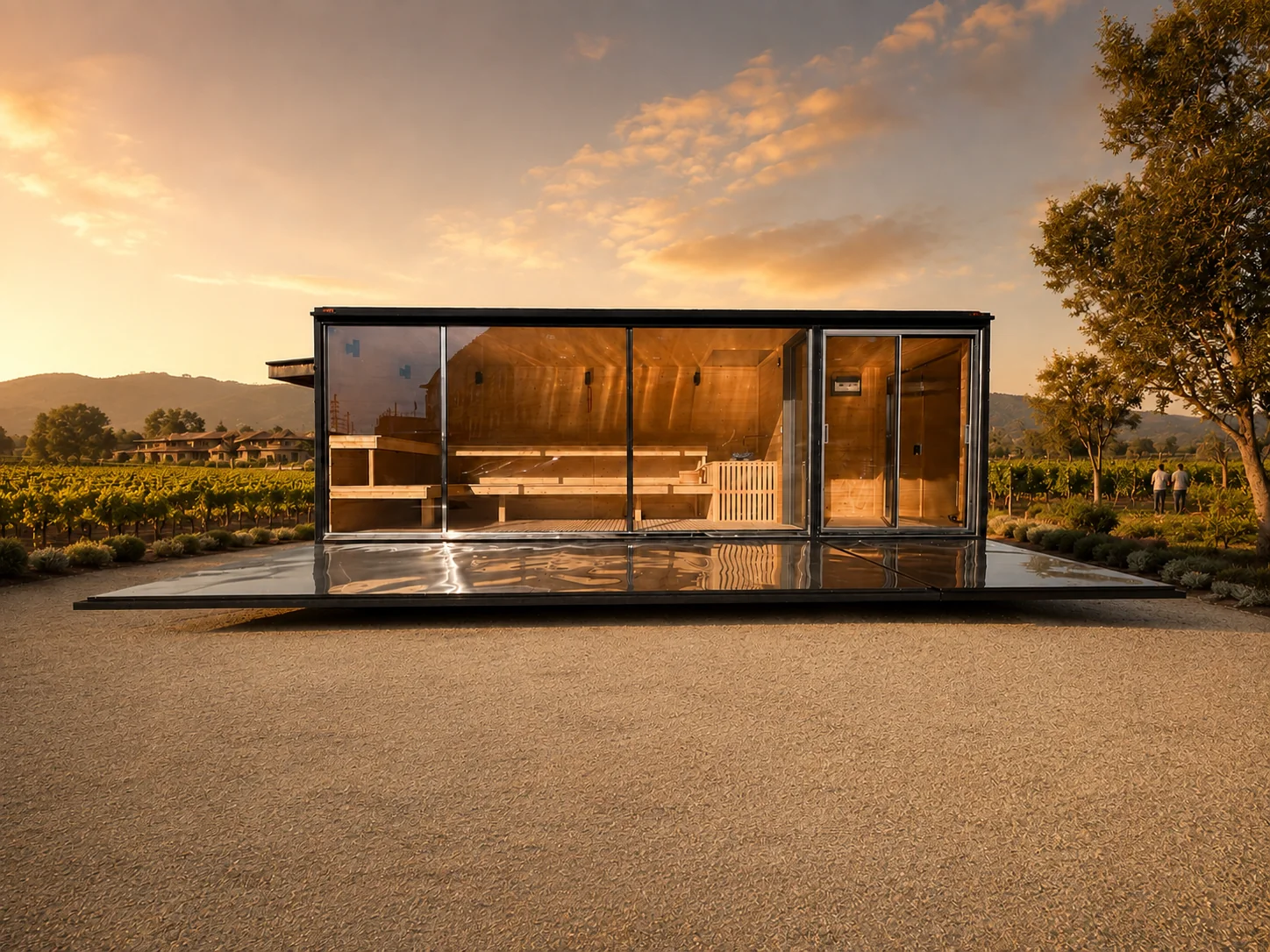
A winery or resort should test a specific bookable sauna experience before committing to a full launch. Define the guest, occasion, price hypothesis and operating constraints; present a transparent expression-of-interest or refundable-reservation offer; measure qualified behaviour rather than likes; and do not accept bookings for dates that the venue cannot responsibly support. Proceed only when demand, site, operating, approval and supplier evidence pass separate gates.
A mobile or relocatable sauna can support a distinctive wellness experience, but the commercial case depends on the venue, guest journey and operating system. A pre-sale test should reduce uncertainty without suggesting that an unconfirmed installation already exists.
This guide is general planning information. It is not legal, financial, tourism-accreditation, planning, building, safety, medical, engineering or insurance advice.
Start with the experience, not the equipment
Write one sentence describing the proposed experience. For example: a pre-booked private sauna session for adult accommodation guests at a regional property, offered at defined times and integrated with the stay. The sentence should identify the buyer, setting, occasion and booking model.
Avoid combining day visitors, groups, retreats, members, weddings and casual walk-ins in the same first test. Different segments create different circulation, privacy, staffing and commercial requirements.
Tourism Western Australia’s experience-development material emphasises market readiness, business-case development, feasibility and planning. Use those principles to test whether the sauna strengthens the venue’s existing story rather than becoming an isolated amenity.
The winery and tourism experience-design guide provides a broader guest-journey framework.
Define the decision and evidence threshold
Choose the question that the test must answer. Examples include whether overnight guests will reserve a private add-on, whether midweek couples respond to a packaged experience, or whether an existing membership or retreat audience will pay at a stated price.
Set thresholds before promotion. Track the number of eligible people reached, landing-page visits, qualified enquiries, completed calls, reservation requests, cancellations and objections. If money is not accepted, label the result as interest rather than paid demand.
Create separate gates for demand, site feasibility, approvals, operating readiness and supplier evidence. Strong demand does not make an unsuitable location acceptable.
Choose an honest pre-sale format
Where product, installation or launch dates are not final, begin with an expression of interest or waitlist. Explain that the venue is evaluating the experience, what information is confirmed and when participants will receive an update.
A refundable reservation may provide a stronger signal, but it needs clear terms covering what is reserved, the amount, refund triggers, cancellation, timing, minimum conditions and what happens if the project does not proceed. Obtain Australian legal advice before accepting money.
The ACCC states that a business must not accept payment when it knows, or should know, it cannot supply by the promised date or within a reasonable time. Do not sell a dated guest session before the venue, product and operating plan can support that promise.
Build a focused landing page
Use actual Mobile Sauna Systems product images and label the project stage accurately. The page should include:
- the intended venue and guest segment;
- a concise description of the proposed experience;
- what is included and excluded in the test;
- the proposed timing expressed cautiously;
- accessibility and suitability information that is currently known;
- confirmation that final site and operating checks are required;
- the price hypothesis or reservation condition, if approved;
- privacy and contact information; and
- one clear action, such as join the qualified waitlist or request a venue discussion.
Do not present digitally refined backgrounds as proof of an installed venue. A caption can explain that the image uses the actual system in a presentation setting.
Recruit the right test audience
Begin with people who resemble future guests: recent accommodation customers who have consented to relevant marketing, retreat enquiries, existing member lists with appropriate permission, or an approved sample recruited through the venue’s normal channels.
Avoid buying a broad consumer list. If email or SMS is used, Australian spam rules generally require consent, sender identification and a functional unsubscribe method. Keep service messages separate from promotional content where appropriate.
Venue partners can also conduct a controlled interview study. Ask about actual booking behaviour, preferred time, private versus shared use, price sensitivity, barriers, weather, partner participation and what information would increase confidence.
Test the complete guest journey
Map discovery, eligibility information, booking, arrival, orientation, changing, movement to the sauna, session, cooling, post-session transition and departure. Identify privacy conflicts, wet circulation, noise, sightlines and staff handovers.
The commercial recovery capacity and guest-flow guide helps translate session length and changeover into a timed plan. Do not increase projected revenue by assuming impossible turnover.
Record which parts of the journey are existing venue capabilities and which require construction, services, staff or supplier work. The test should not conceal those dependencies.
Pass the site gate before promising delivery
Assess site control, vehicle or delivery access, ground conditions, setbacks, utilities, drainage where relevant, weather exposure, guest circulation, emergency access, lighting, security and maintenance access. Confirm the local approval and professional-advice pathway for the specific proposal.
A relocatable system is not automatically exempt from planning, building, electrical, public-health, fire, accessibility or workplace responsibilities. Use the WA approvals checklist to structure questions without claiming a universal answer.
Model the commercial case conservatively
Keep demand evidence and forecast assumptions separate. Model available sessions, realistic paid occupancy, realised price, package allocations, partner commissions, staff time, cleaning, linen, utilities, maintenance, insurance, booking fees, marketing, downtime and cancellations.
Do not treat the full rack rate as realised revenue when packages, discounts or commissions apply. Include the opportunity cost of staff and space. Test downside cases for lower occupancy, weather interruptions, maintenance and delayed launch.
The mobile sauna commercial KPI guide provides definitions for separating enquiries, bookings, attendance and contribution.
Prepare operating and safety evidence
Before serving guests, create documented opening, guest-information, suitability, supervision, cleaning, incident, fault and closing procedures. Define who may stop a session and remove it from sale. Train staff and retain records.
Avoid medical claims in the pre-sale campaign. Describe the experience and commercial setting accurately. Suitability information and exclusions should be reviewed with appropriate professionals for the operating model.
Photography, testimonials and customer results require permission and a traceable source. A pilot participant’s positive comment should not be broadened into a universal outcome.
Make the decision from a written scorecard
At the end of the test, compare actual results with the pre-set thresholds. Review qualified demand, price response, audience fit, booking friction, site feasibility, operating workload, approval pathway, supplier evidence and financial sensitivity.
Possible outcomes are proceed to detailed design, revise the experience, test a different segment, establish a venue partnership, or stop. Preserve reasons for non-purchase; they often identify the next information or product evidence needed.
Common market-test mistakes
- Promoting a concept to an audience that does not resemble paying guests.
- Counting social reactions as reservations.
- Showing a refined image as a completed installation.
- Announcing a launch date before site and supplier gates pass.
- Testing price, audience, package and channel simultaneously.
- Omitting changeover, cleaning and staff time from capacity.
- Accepting money without reviewed conditions and refund mechanics.
- Using unverified health, approval or financial-return claims.
- Continuing because of enthusiasm after a critical gate fails.
Frequently asked questions
Can a winery test demand without owning a sauna yet?
Yes, an accurately labelled expression-of-interest test can measure message response and qualified intent. It does not prove operational feasibility or a completed sale.
Should the venue advertise an opening date?
Only when the venue has a defensible delivery, site, approval and operating plan. Earlier campaigns should describe the evaluation stage and update process clearly.
Is a waitlist enough to justify the purchase?
A waitlist is an early signal. Buyer quality, price response, site feasibility, operating requirements and supplier evidence still require assessment.
What should be measured during the test?
Measure eligible reach, qualified enquiries, calls, reservation requests, price objections, timing preferences, site questions and withdrawal reasons. Do not combine incomplete enquiries with confirmed reservations.
Can the sauna be packaged with accommodation or wine experiences?
Potentially, subject to responsible service, venue operations, suitability, licensing and professional advice. Test a coherent itinerary rather than assuming each component combines automatically.
How can a winery or resort discuss a Mobile Sauna Systems project?
Share the property, guest segment, proposed site and commercial goal through the commercial enquiry form or call 0432 394 901.
Sources and limitations
- Tourism Western Australia — Experience development
- Tourism Western Australia — Operator resources
- ACCC — Supplying products or services that are paid for
- ACMA — Avoid sending spam
- Australian Government — Do market research
This is general planning information, not legal, financial, tourism-accreditation, planning, building, safety, medical, engineering or insurance advice. Confirm requirements for the venue, location and proposed experience.
Plan your commercial system
Start with your venue, audience and operating goal.
Tell Mobile Sauna Systems about the proposed site and commercial opportunity so the right questions can be framed for a qualified project discussion.
This article provides general information only and is not medical, legal, planning, engineering or financial advice. Requirements vary by project and jurisdiction. Seek appropriately qualified advice for your circumstances.