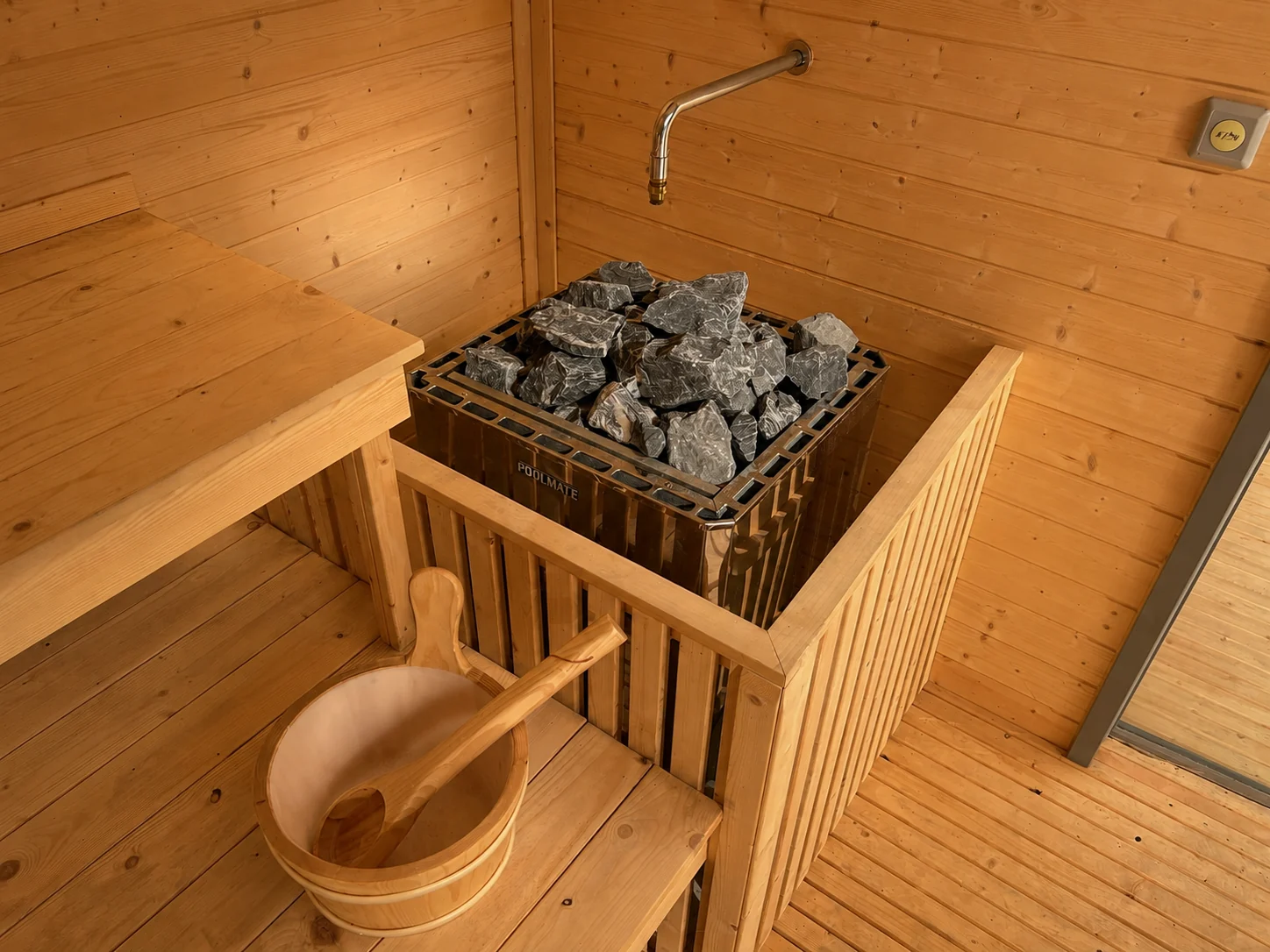
An accommodation sauna is feasible when the guest promise, site, approvals, staff capacity and conservative economics work together. Test the concept with a written offer, a mapped guest journey, a verified site and services review, an operating plan and three financial scenarios. Do not justify the project with an assumed occupancy lift or universal wellness claim. Decide which measurable behaviour—package uptake, paid sessions, midweek demand, repeat use or guest satisfaction—the experience is intended to influence, then pilot before scaling where practical.
A sauna can give a resort, hotel, farm stay or regional retreat a strong sense of place. It can also create new booking, housekeeping, maintenance and duty-of-care tasks. The useful feasibility question is therefore not “would guests like a sauna?” It is “can this property deliver a safe, distinctive and commercially coherent experience repeatedly?”
This workbook is designed to be completed by the owner, accommodation manager, operations lead and relevant advisers. It does not supply a generic revenue forecast, product specification, approval or health protocol. Use verified inputs from your property and proposed system.
For experience design across winery and resort settings, see the venue planning guide. For a full cost model, use the mobile sauna business cost framework.
Worksheet 1: State the guest promise
Write one sentence completing this prompt: “For [specific guest], this experience provides [specific occasion] in [distinctive setting], delivered through [clear service format].”
Examples of occasions might include a private sunset booking, a post-hike warm-up, a couples’ retreat ritual or a small-group recovery session. These are experience descriptions, not promises of medical benefit.
Then answer:
- Which existing guest segment is the priority?
- Is the experience included, paid separately or packaged?
- Is it private, shared, supervised or self-directed?
- What makes it specific to this property rather than a generic add-on?
- What will guests understand before booking?
- What is deliberately outside the offer?
Choose one primary commercial objective. Options may include paid-session contribution, package uptake, stronger midweek offer, a premium room inclusion, an event add-on or improved guest experience. Avoid listing every possible benefit; that makes later results impossible to interpret.
Worksheet 2: Test demand without overclaiming
Use property evidence before broad market claims. Review enquiries, guest surveys, booking notes, post-stay feedback, activity bookings and staff observations. Search for questions about private wellness, outdoor experiences, recovery, rainy-day options or group activities. Separate stated interest from willingness to book or pay.
Run structured conversations with a small mix of recent guests or target customers. Show the proposed service honestly, including session type, availability, location and indicative price only if authorised. Ask what would make them book, what would stop them, whether they prefer private or shared access, and how it fits the stay.
A landing-page or concierge test can measure enquiry before build, but clearly label the concept as proposed and do not take payment for an unavailable service. Record the number of eligible guests exposed to the offer, not just clicks from a general social audience.
Create three demand cases:
- Conservative: limited awareness, low initial uptake and realistic closures.
- Working: evidence-based uptake after the operating rhythm is established.
- Capacity-constrained: demand reaches the service’s safe operating limit.
The third case is not an aggressive sales forecast. It tests what happens to staffing, cleaning, queues and guest access when the service is full.
Worksheet 3: Map the property fit
Mark candidate positions on a site plan. Evaluate each against arrival, views, privacy, noise, guest rooms, parking, staff access, existing amenities, emergency response, delivery route, terrain, weather, bushfire or flood context, services and future property plans.
A photogenic location can be operationally weak if it is far from change facilities, crosses vehicle traffic, lacks a safe night path or cannot be reached by emergency services. Score the guest view and the service route separately.
For a relocatable unit, survey the route from public road to final position, including gates, turns, grades, branches, overhead services, soft ground and exit. Use the delivery and placement checklist in this approval batch before calling the site ready.
Document verified electrical and other service needs. In Western Australia, appropriately licensed people must perform electrical installation work. Engage a licensed electrical contractor using final equipment information, not a generic assumption.
Ask the local government and other relevant parties about planning, building, public-use, accessibility, environmental or activity requirements. The Australian Government explains that licences and permits vary with the business, activity, state and local area; ABLIS is a useful starting point. Keep written project-specific outcomes.
Worksheet 4: Walk the complete guest journey
Map the experience minute by minute:
- Discovery: Where does the guest first see accurate information?
- Booking: Is capacity, privacy, timing and suitability clear?
- Pre-arrival: What should the guest bring and when should they arrive?
- Check-in: Who verifies the booking and provides instructions?
- Changing: Where are belongings, towels, robes and wet items managed?
- Access: Is the path safe, lit, private and understandable in poor weather?
- Session: How are time, occupancy, conduct and assistance controlled?
- Cooling or transition: Where can the guest rest, hydrate or move to another element?
- Departure: How does the next booking avoid conflict?
- Reset: Can staff clean, inspect and restock within the schedule?
Test the journey for a late arrival, mobility limitation, sudden rain, staff call-away, guest who wants to leave early, maintenance fault and adjacent event. If a process only works when nothing unexpected happens, it is not ready.
Where an accommodation package includes alcohol or another venue activity, obtain appropriate advice and set explicit operating rules. Do not allow the marketing team and operations team to hold different assumptions about who can participate.
Worksheet 5: Select the format
Compare road-towable trailer, occasionally relocated pavilion and fixed integration using the intended movement pattern, site access, services, planning pathway, guest capacity, aesthetics, maintenance access and future flexibility.
A mobile sauna trailer can support seasonal repositioning, events or a lower-impact arrival to an existing property where the site is suitable. A relocatable pavilion may suit a destination-scale experience moved infrequently. A fixed sauna may integrate closely with existing buildings and amenities but requires a different project pathway.
Read the trailer versus pavilion versus fixed comparison and require each supplier proposal to state inclusion, exclusion and assumptions. Do not use “mobile” as shorthand for easy, approval-free or ready to tow.
Worksheet 6: Design the operating model
Calculate usable sessions from opening hours, session duration, arrival buffer, cleaning and inspection time, staff breaks and planned maintenance. Do not multiply every hour by theoretical seating capacity.
Assign responsibility for bookings, guest information, check-in, supervision, cleaning, daily checks, faults, maintenance, first aid, incident response and closing. Decide whether the property can carry these tasks during check-in and breakfast peaks.
Create a controlled operating file using the commercial sauna operating-procedures guide in this approval batch. Include equipment and manufacturer instructions, venue risk controls, cleaning, maintenance, emergencies and staff training.
If the experience includes cold plunge or red-light equipment, assess each as its own operating system. Water treatment, wet-area movement, specific equipment instructions and claims governance may add significant work. Do not bundle modalities simply because they look attractive in a package description.
Worksheet 7: Model the economics
List initial project costs using verified quotes: system, design, approvals advice, delivery, site works, electrical and other services, platform or access, landscaping, signage, booking configuration, training, professional fees, insurance changes and launch assets. Separate included items, optional items and contingencies.
List recurring costs: labour, cleaning, laundry, energy, water, consumables, booking fees, maintenance, inspections, insurance, marketing, downtime allowance and replacement reserve. Include management time. A task does not become free because an existing staff member performs it.
For paid sessions, calculate contribution per delivered session as revenue less variable cost. For included experiences, choose a measurable commercial behaviour such as package premium or relevant booking conversion, but do not attribute every change to the sauna without a comparison.
Run the conservative, working and capacity-constrained cases. Change price, utilisation, cancellations, staffing, seasonality, closure days and variable cost. State every assumption. The result is a decision model, not a promise of revenue or return.
Set a stop or redesign rule before launch—for example, if reset time remains above the schedule, if the approved staffing model cannot be maintained, or if paid uptake stays below the conservative threshold after a defined test. Pre-agreed rules reduce emotional commitment to a weak format.
Worksheet 8: Prepare factual marketing
Build messages from verified facts: format, location, session type, capacity where approved, booking method, what is included and the character of the experience. Avoid invented provenance, environmental performance, wellness outcomes or comparisons.
The TGA’s advertising guidance requires relevant therapeutic-goods advertisements to be accurate, balanced, not misleading and substantiated. If red-light or other equipment is represented as a therapeutic good, confirm its status and permitted claims for the actual product. More broadly, these standards are a useful discipline for the complete guest offer.
Create an evidence file linking every material claim to an approved source. Train reservations, reception and experience staff to use the same language. Influencer or partner content should not introduce unsupported health promises.
Worksheet 9: Pilot and measure
Where practical, run a controlled pilot with defined dates, hours, eligible guests, staff, price or inclusion and capacity. Keep approval, site and safety obligations intact; “pilot” is not an exemption.
Measure:
- offer views among eligible guests;
- booking or package uptake;
- show, cancellation and rebooking rates;
- delivered sessions and usable capacity;
- contribution using actual variable costs;
- repeat use during a stay where relevant;
- staff, cleaning and reset time;
- faults, downtime, incidents and complaints;
- satisfaction with the booking, privacy, cleanliness and setting; and
- impact on other venue operations.
Use qualitative interviews to understand why people booked or declined. A high satisfaction score among a small number of enthusiasts does not prove broader demand. Conversely, low uptake may reflect unclear packaging rather than the experience itself. Change one major variable at a time where possible.
Common feasibility mistakes
- Asking “do you like saunas?” instead of testing a specific offer and willingness to book.
- Assuming the experience will increase room occupancy without a comparable baseline.
- Choosing the most photogenic site before access, services and emergency response are checked.
- Ignoring housekeeping, towels, cleaning, bookings and staff handover.
- Treating a relocatable format as free from approval or site obligations.
- Combining sauna, plunge and red light before one service is operated well.
- Using wellness trends or elite-sport examples as proof for every guest.
- Building a financial case from maximum theoretical capacity.
- Publishing therapeutic or environmental claims without product-specific evidence.
- Launching without stop rules, review dates or a defects process.
Make the feasibility decision
Score the project in five gates: guest proposition, site and approvals, operating capability, verified system scope, and conservative commercial case. Each gate should be green, conditional with named actions, or stop. A high overall average must not hide a critical red item.
If the project proceeds, convert the workbook into the supplier brief and implementation plan. Mobile Sauna Systems can help discuss relocatable commercial sauna and recovery concepts, while the property and its advisers confirm site, approvals, specifications, operations and economics.
Frequently asked questions
Will a sauna increase accommodation bookings?
It may strengthen a particular offer, but no universal uplift should be assumed. Define the intended booking behaviour, establish a baseline and test uptake, contribution and guest feedback using the property’s own evidence.
Should the experience be included or charged separately?
Compare both models against capacity, guest expectations, staffing and the property position. Included access can be simple to communicate but difficult to control; paid bookings can support capacity and contribution but add purchase friction.
What is the best location on a resort or farm stay?
The best location balances guest setting with safe access, privacy, services, drainage, weather, staff visibility, emergency response, approvals and future relocation or maintenance. The strongest view alone is not enough.
Can an accommodation business start with a mobile sauna pilot?
Potentially, if the selected format and site are suitable and every approval, service, safety, insurance and operating requirement is still satisfied. Define the pilot period, audience, capacity, measures and stop rules in advance.
What evidence should be ready before marketing?
Keep approved product and format details, site and booking information, capacity and operating rules, image permissions and support for every material performance, health, provenance or environmental claim. Remove any claim that cannot be substantiated.
Sources and further checks
Plan your commercial system
Start with your venue, audience and operating goal.
Tell Mobile Sauna Systems about the proposed site and commercial opportunity so the right questions can be framed for a qualified project discussion.
This article provides general information only and is not medical, legal, planning, engineering or financial advice. Requirements vary by project and jurisdiction. Seek appropriately qualified advice for your circumstances.