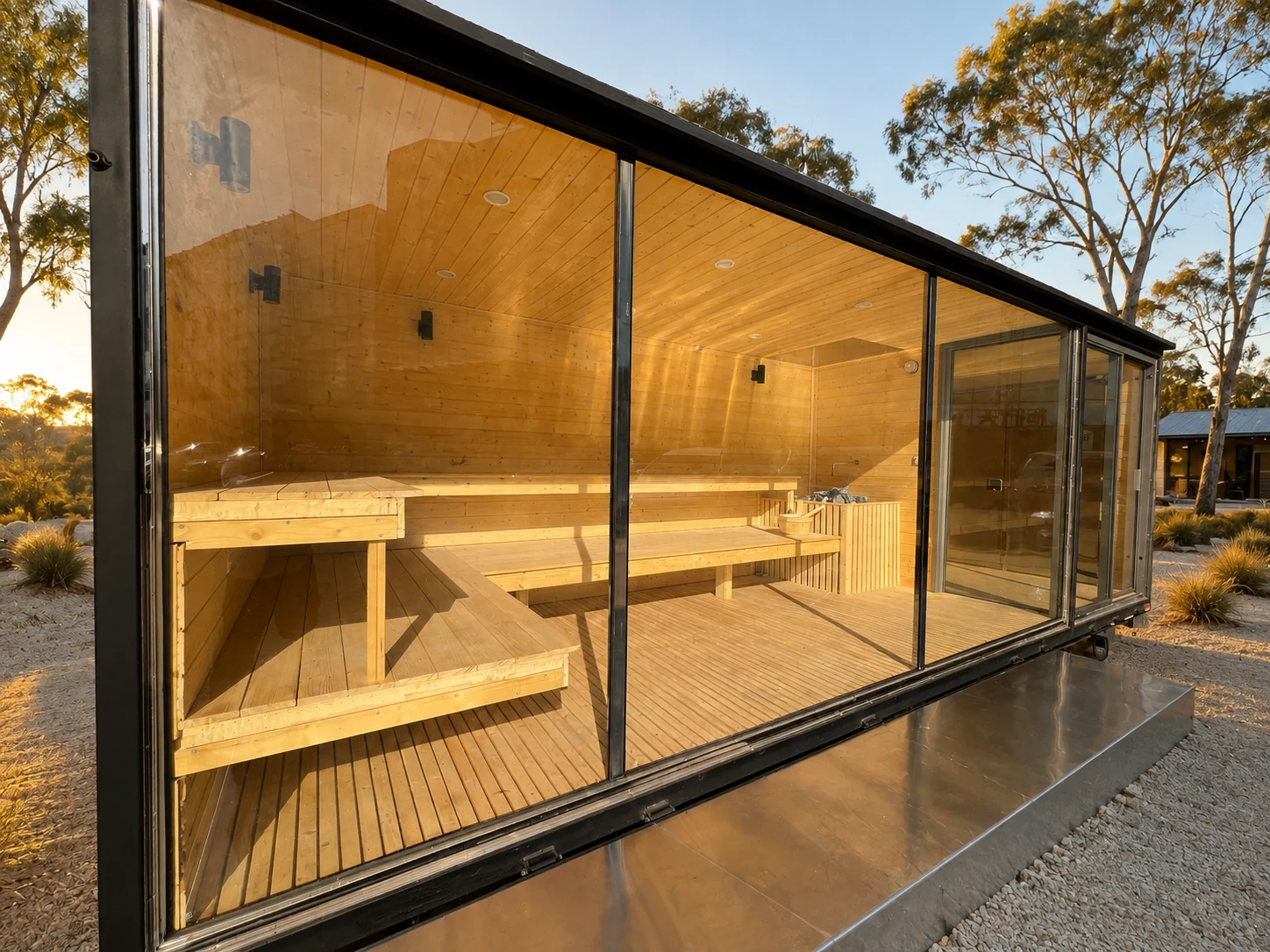
Choose a road-towable sauna trailer when frequent road movement is central to the business, a relocatable pavilion when a premium venue experience and occasional movement matter, and a fixed sauna when the facility is intended to remain integrated with one site. The right answer depends on movement frequency, guest experience, site services, transport method, approvals, staffing and whole-of-life cost—not on the word “mobile” alone.
Three projects can all be described as mobile saunas while operating very differently. A trailer might travel between events each week. A relocatable pavilion might spend a season at a winery and move by specialist transport. A fixed sauna might be built into a resort’s permanent recovery area. Treating these as interchangeable leads to poor comparisons.
This guide frames the decision for commercial Australian buyers. It is not a technical approval or compliance assessment. Final requirements must be checked for the selected design, vehicle or structure, site and jurisdiction.
Use it alongside the Mobile Sauna Systems commercial overview and carry the preferred format into a site-specific project enquiry.
Define the three formats clearly
Road-towable sauna trailer
A trailer is designed around road movement and must be assessed as a vehicle as well as a guest facility. The Australian Government’s road-vehicle standards framework applies to vehicles and trailers supplied for road use. For trailers with an aggregate trailer mass of 4.5 tonnes or less, the Low ATM Trailer process explains approval pathways, Register of Approved Vehicles entry and applicable Australian Design Rules.
The practical advantage is planned mobility. The trade-off is that dimensions, mass, towing, load distribution, stabilisation, roadworthiness and setup all become part of the operating system. A beautiful room that is difficult to tow, level, secure or reset is not a successful mobile business asset.
Relocatable sauna or recovery pavilion
A relocatable pavilion is designed to be moved, but not necessarily towed on public roads by the operator. It may be placed by truck, tilt tray, crane or another specialist method. This can support a more architectural guest experience, a larger hospitality presence or integration with adjacent red-light and cold-plunge elements.
Occasional movement can still be complex. The buyer needs a defined lift or transport method, lifting or support points where relevant, access clearances, service-disconnection plan, ground requirements and responsibilities for every move. “Relocatable” should describe a documented process, not a possibility left to the future owner.
Fixed sauna
A fixed sauna is intended to remain at one venue and may be integrated with permanent services, amenities and building works. It can be appropriate where the venue has a stable location, a clear long-term demand case and an established development pathway.
Fixed does not automatically mean simpler. It can involve more site integration and permanent works. Its strength is that road movement does not dictate the design and the guest journey can be planned as part of the wider property.
Compare how often the system must move
Movement frequency is the first filter. Write down the expected moves per year and the reason for each move.
- Weekly or event-led relocation makes repeatable towing and rapid setup central.
- Seasonal movement requires a reliable transport and reconnection plan, even if moves are infrequent.
- A contingency ability to move is different from an operating model built around movement.
- No planned movement points toward a fixed or site-integrated approach.
Then record the complete movement cycle: booking transport, preparing the unit, isolating services, securing internal items, towing or lifting, arrival, stabilisation, reconnection, inspection, cleaning and reopening. Include the people, qualifications, equipment and time required. A format that moves in theory may be commercially unsuitable if each move consumes several trading days or relies on scarce equipment.
Compare the guest experience
The guest sees the arrival sequence, exterior, threshold, room, view, comfort and relationship to other venue facilities. The format should support the experience the business wants to sell.
A trailer can create a distinctive pop-up experience and bring the service to events or partner venues. Space and circulation may be constrained by vehicle requirements. A pavilion can provide a strong standalone identity and may better support a premium destination setting, but its placement and service needs can be more substantial. A fixed sauna can integrate closely with showers, changing areas and existing operations, but it cannot be redeployed if the demand case changes.
Use a scaled plan and an operating walkthrough. Test arrival, check-in, storage, changing, session briefing, movement to and from any cold-plunge element, cleaning and departure. Review the experience in wet weather, after dark and during a full changeover.
Compare site and service needs
Every format needs a suitable site. The questions vary in emphasis:
Trailer questions
- Can the tow vehicle and trailer safely access, turn and exit?
- Is there a stable setup area with appropriate clearance?
- How will the unit be levelled and secured?
- Where do power, lighting and other service routes cross guest paths?
- What is the plan if weather or ground conditions change?
- Where can the tow vehicle park during operation?
Relocatable pavilion questions
- What transport and placement equipment is required?
- Are access width, height, turning and lifting conditions suitable?
- What foundation or support method is assumed?
- Can services be disconnected and reconnected without improvised work?
- Who certifies or inspects the unit after placement where required?
Fixed sauna questions
- How will the sauna integrate with the existing building and services?
- What permanent works are required?
- How does the location affect fire, egress, accessibility, ventilation and neighbouring uses?
- Can the venue maintain access for future service and replacement?
Do not infer that one format is exempt from approval. The Australian Business Licence and Information Service can help identify licences and permits based on activity and location. Local government and qualified project advisers remain important because site and proposal details determine the pathway.
Compare regulatory workstreams
Keep these workstreams separate in the decision register:
- Road vehicle and registration matters for a road-towable trailer.
- Planning, building and land-use matters for the proposed placement and operation.
- Electrical design, installation, connection and certification.
- Workplace and public risk controls.
- Business, insurance and venue-specific operating requirements.
For a trailer, the Australian Government’s Register of Approved Vehicles and Australian Design Rules may be relevant before state or territory registration. For electrical work in Western Australia, the WA Government states that the appropriate electrical licences are required. For risk management, Safe Work Australia’s model code recommends identifying hazards, assessing risks where necessary, implementing controls and reviewing them.
Completing one workstream does not close the others. For example, vehicle approval does not confirm that a venue can operate the experience at a particular site.
Compare operating effort
The visible asset is only part of the workload. Estimate staff minutes for opening, heating, briefing, session supervision, reset, cleaning, testing and closing. Add relocation tasks for a trailer or pavilion. Consider how the business handles late guests, weather interruptions, equipment faults and maintenance downtime.
A mobile event operator may accept more setup effort in exchange for access to multiple markets. A resort may prioritise simple integration with front-desk and housekeeping teams. A winery may need the system to complement tastings and food service without creating a separate operational burden.
Assign an owner to each task. If a task has no owner, the format comparison is incomplete.
Compare total cost, not purchase price
Build a whole-of-life worksheet with the same categories for all three formats:
- design and documentation;
- asset or construction cost;
- delivery, towing equipment, lifting or placement;
- site preparation and service connections;
- permits, qualified advice and inspections where required;
- booking, payment and guest-management setup;
- staff training and launch;
- energy, water and consumables;
- cleaning, maintenance and replacement allowance;
- insurance and storage where relevant;
- relocation cost and lost trading time; and
- residual value or relocation flexibility, treated as an assumption rather than a guarantee.
Model a conservative operating case. For each format, calculate expected contribution per trading day and subtract the format-specific fixed and movement costs. Do not insert a supplier’s promotional occupancy claim unless you have evidence that it applies to your venue and audience.
A decision matrix that reveals trade-offs
Score each format against weighted criteria. Suggested criteria include relocation frequency, setup time, guest capacity, premium presentation, service availability, approval complexity, staff workload, weather resilience, accessibility objective, expansion potential and cost certainty.
The weighting is more important than the score. A touring wellness operator might give mobility a weight of 20 percent, while an accommodation provider might assign it 2 percent and give guest integration 20 percent. Record who agreed the weights and why.
Then perform a “failure test.” Ask what would make each format unworkable: towing limits, unavailable lifting access, insufficient power, unacceptable guest circulation, unresolved land-use pathway or an operating cost that exceeds the conservative model. Resolve those issues before design preferences dominate the decision.
Common comparison mistakes
- Using “mobile” to mean both road-towable and occasionally relocatable.
- Comparing a basic trailer shell with a site-ready pavilion proposal.
- Ignoring the setup and shutdown labour attached to frequent movement.
- Treating renders as evidence of dimensions, performance or completed projects.
- Assuming vehicle compliance resolves site operating requirements.
- Leaving transport, lifting and service disconnection outside the proposal.
- Selecting capacity before mapping the guest and staff journey.
- Modelling optimistic utilisation without a conservative case.
Which format suits which commercial use?
A trailer can suit an operator whose product depends on travelling to events, beaches, clubs or partner sites and who can manage towing and setup consistently. A relocatable pavilion can suit a venue or operator that wants a strong destination presence with the option to reposition seasonally or as the site develops. A fixed sauna can suit a property with permanent amenities, stable demand and a long-term location strategy.
These are decision patterns, not promises. The most appropriate solution emerges only after the site, movement, services, guest model and authority pathway are assessed together.
Frequently asked questions
Is a sauna trailer better than a fixed sauna?
Not universally. A trailer offers planned road mobility, while a fixed sauna can integrate more deeply with a permanent venue. Compare the expected movement, site, guest journey, approval workstreams, staff effort and whole-of-life cost for the actual business.
What is the difference between mobile and relocatable?
In commercial planning, “mobile” often implies repeat movement, but the term is used loosely. A road-towable trailer, a truck-moved pavilion and a modular structure may all be marketed as mobile. Ask for the exact transport method, frequency, setup process and applicable requirements.
Does a sauna trailer need vehicle approval in Australia?
Road-towable trailers can be subject to the Road Vehicle Standards Act framework, approval pathways, the Register of Approved Vehicles and applicable Australian Design Rules before state or territory registration. The requirements depend on the trailer, so check the official pathway and obtain qualified advice.
Can a relocatable pavilion stay at one site permanently?
It may be designed to remain for long periods, but the appropriate placement and approval pathway depends on the design, land use and jurisdiction. Being capable of relocation does not itself confirm that permanent or long-term operation is approved.
Which format is easiest to finance?
That depends on the buyer, asset, lender, security, project documentation and operating case. Prepare a clear scope, evidence-based costs, conservative cash-flow scenarios, responsibilities and approvals plan. Seek financial and legal advice for the specific transaction.
Plan your commercial system
Start with your venue, audience and operating goal.
Tell Mobile Sauna Systems about the proposed site and commercial opportunity so the right questions can be framed for a qualified project discussion.
This article provides general information only and is not medical, legal, planning, engineering or financial advice. Requirements vary by project and jurisdiction. Seek appropriately qualified advice for your circumstances.