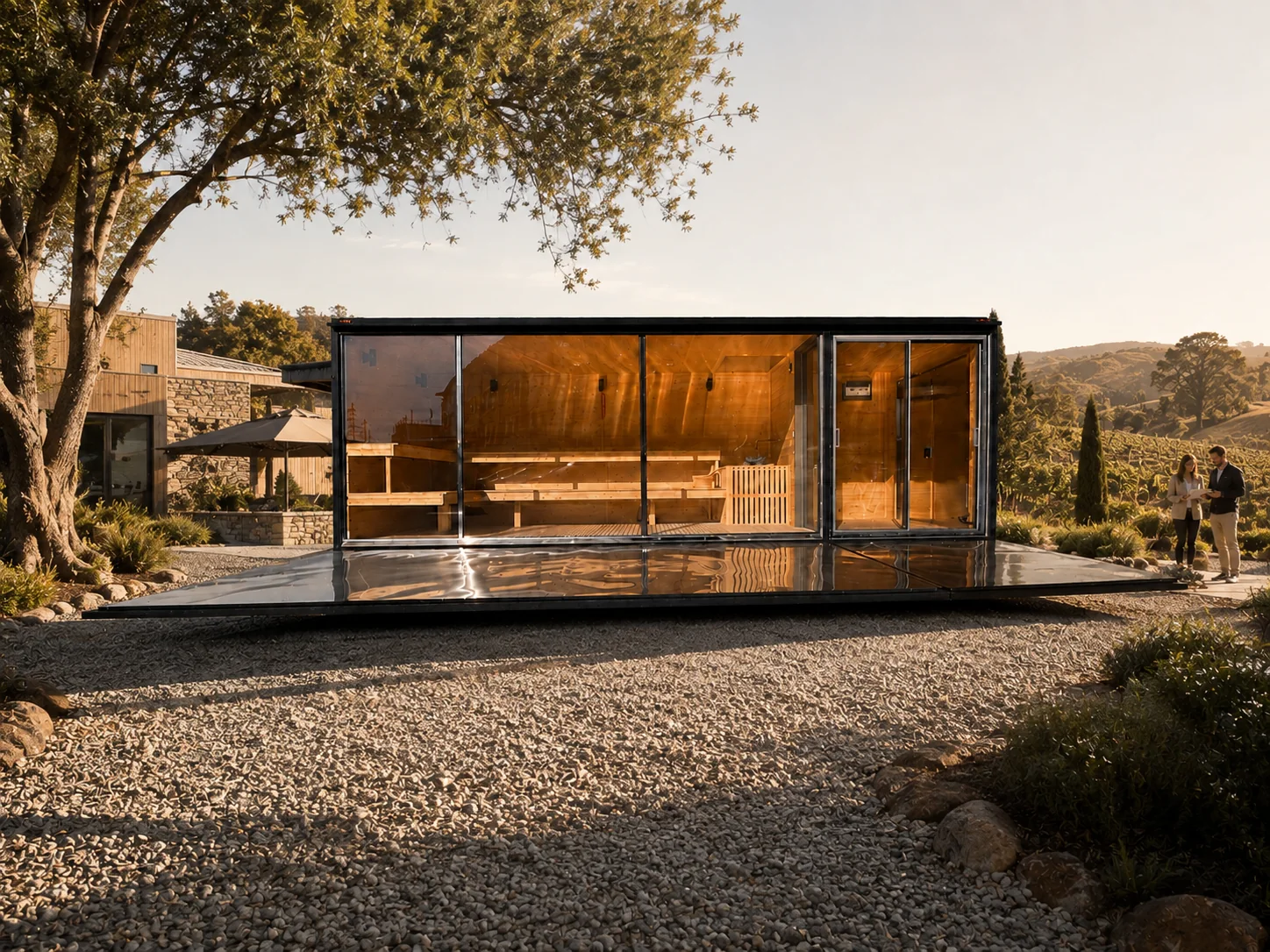
An effective sauna factory visit verifies the exact supplier, exact production site and exact configuration you may buy. Arrive with a controlled specification, inspect materials and components against documents, trace quality checks from incoming goods to final release, test critical functions, record defects and change requests, and leave with an evidence register rather than verbal promises. Australian import, electrical, vehicle, building and site obligations must then be confirmed through the relevant pathways and advisers.
A polished showroom and a friendly meeting are useful introductions, but they are not proof of repeatable production. The visit should reduce the risks that affect delivery, compliance, warranty, installation and the buyer promise.
This guide provides general procurement planning only. It is not engineering, electrical, legal, customs, biosecurity, road-vehicle, building, safety or insurance advice.
Define the decision before travelling
Write what the visit must allow you to decide. Examples include whether the factory can build the proposed configuration consistently, whether it owns or controls the claimed production stages, whether the evidence supports the Australian pathway, and whether the supplier can manage defects and spare parts after delivery.
Separate “must pass” criteria from preferences. A finish colour may be negotiable; traceable component information, structural evidence or an agreed quality-control process may be a gate. Use the commercial supplier proposal scorecard to carry the same comparison logic into the visit.
Freeze the inspection configuration
Ask the supplier to identify the exact model, drawing revision, option list and bill-of-materials version you will inspect. A sample can differ from the product later manufactured. Record every difference.
Create a configuration sheet covering the overall form, dimensions, intended capacity, mass data, chassis or base, glazing, timber, insulation, heater, controls, ventilation, electrical equipment, water-related components where relevant, doors, hardware, lighting, finishes, transport features, markings, documentation and included accessories.
Do not publish these values until they are approved and linked to the final configuration. A supplier brochure, test report and product label must refer to the same item before they are treated as one evidence set.
Verify the supplier and production site
Confirm the legal business name on the proposed contract, the entity issuing invoices, the factory address, the export party and any trading company or subcontractor. Ask which activities occur at the site and which are outsourced.
Walk the material-receipt, fabrication, assembly, finishing, electrical, testing, packing and dispatch areas. Ask staff to explain the process using a current production order. Look for work instructions, revision control, inspection records and quarantine of non-conforming material.
This is not an invitation to conduct covert surveillance. Obtain permission before taking photographs, copying records or interviewing staff. Record when evidence was observed and who explained it.
Inspect materials and components
Compare physical labels and supplier records with the controlled specification. Important categories may include:
- structural frame, chassis and running gear where applicable;
- timber species, grade, finish and moisture-management approach;
- insulation and lining systems;
- glazing composition and safety information;
- heater, controller and protective equipment;
- cables, switches, lighting and distribution components;
- ventilation openings and airflow provisions;
- fixings, hinges, seals and door hardware;
- water fittings or pumps where included; and
- packaging materials and transport restraints.
Ask how substitutions are approved. A component that appears equivalent may change performance, evidence or serviceability. Require written approval before a material or component change to an ordered configuration.
Examine the evidence, not only the certificate cover
For each report or certificate, record the issuer, document number, date, scope, standard or requirement, tested model, listed components, limitations and current status. Check whether the issuer is independent, whether the document is a test report, certification, supplier declaration or laboratory summary, and whether the inspected configuration matches it.
Avoid statements such as “Australian approved” unless the responsible Australian pathway has been completed and the claim can be made accurately. Foreign conformity marks may be relevant evidence but do not automatically settle Australian import, electrical, vehicle, planning or workplace obligations.
Create an evidence register with one row per claim. Mark each row verified, partial, superseded, missing or requiring Australian professional review.
Review quality control from start to finish
Ask what is checked at material receipt, during production and before release. A useful quality plan identifies the characteristic, method, tolerance, frequency, record, responsible person and response to failure.
Observe whether measuring equipment is suitable and whether records identify the product or batch. Ask for anonymised examples of non-conformance reports and corrective actions. The goal is not a factory with no recorded problems; it is a factory that finds, contains and corrects problems reliably.
Agree on buyer hold points for the first unit. These may include frame completion, concealed services before lining, heater and control installation, glazing, final function testing, mass measurement, water testing where relevant, cleaning and packing. Decide what evidence must be sent before the next production stage proceeds.
Run functional and finish checks
Prepare a checklist before the visit. Verify door operation, seals, glazing condition, benches, guards, exposed edges, fasteners, finishes, lighting, controls, ventilation openings and accessible service points. Where competent testing is required, arrange it with appropriately qualified personnel rather than improvising.
Record warm-up or operating observations only under a defined method. Note ambient conditions, configuration, instruments and duration. Do not turn one demonstration into a universal performance claim.
Inspect cleaning access and maintenance tasks. A component can function in a demonstration yet remain impractical to service at an Australian venue.
Confirm packaging, shipping and biosecurity inputs
Ask for the proposed packing drawing, lift points, centre-of-gravity information where relevant, protective materials, moisture control, tie-down method, container loading approach and unloading assumptions. Identify who is responsible at each transfer.
Record any timber packaging and biosecurity evidence required for entry. Confirm the process with the Australian Department of Agriculture, Fisheries and Forestry or a licensed customs/biosecurity professional. Packaging decisions can affect damage, inspection and delay, so they belong in the commercial specification.
Build the landed-cost model beyond the factory price. Include inspection, packing, inland transport, freight, insurance, port charges, customs services, duties and taxes where applicable, biosecurity, storage risk, local transport, modification, testing, approvals, installation and commissioning. Do not present a provisional landed figure as a public price.
Address the trailer or road-vehicle pathway early
If the system is a trailer or other road vehicle, confirm the Australian approval pathway before shipment. The Department of Infrastructure states that importing a road vehicle requires approval and that an unapproved vehicle may not be released from customs control. For low-ATM trailers, the department describes concessional and vehicle-type approval pathways and Register of Approved Vehicles requirements.
Ask the supplier for the evidence that may support the selected pathway, but have the pathway confirmed by the responsible Australian authority or adviser. Do not assume a supplier’s export history proves suitability for this project.
Use the delivery and placement readiness checklist to connect factory decisions with transport, access and site handover.
Negotiate warranty, spares and defect response
Write down who diagnoses a defect, who supplies parts, who pays freight, which labour is covered, response targets, exclusions, start date and evidence required. Clarify whether a local contractor may work on the product without voiding coverage and how technical support is delivered across time zones.
Agree on a first-delivery spare-parts list based on risk and lead time. Obtain manuals, wiring information, component references and supplier contacts appropriate to the final configuration. A warranty statement without a practical diagnosis and parts process may provide little operational protection.
Close the visit with an action register
Hold a final meeting using a written issue list. For every item record the observation, evidence, owner, required action, due date, approval status and effect on price or schedule. Photograph agreed reference details with permission and label them immediately.
Do not sign a final acceptance merely because travel time is ending. It is reasonable to return with open actions. The decision should follow review of the evidence, updated specification, landed-cost model and Australian advice.
Common factory-visit mistakes
- Inspecting a showroom sample without confirming its relationship to the order.
- Relying on translated summaries instead of the complete evidence.
- Accepting component substitutions verbally.
- Photographing defects without recording the required correction.
- Discussing price while leaving acceptance criteria undefined.
- Assuming overseas certification equals Australian approval.
- Ignoring packaging, unloading, spares and local labour.
- Allowing the supplier to control every demonstration.
- Leaving without document owners and due dates.
Frequently asked questions
Should an Australian buyer use an independent inspector?
Independent inspection can add useful separation when the scope, competence, configuration and reporting method are defined. It does not replace Australian professional or regulatory advice.
What documents should be requested before the visit?
Request the proposed contract entity, drawings, option list, bill of materials, quality plan, report register, manuals, warranty, packing method and draft production schedule. Mark missing items rather than assuming they will appear later.
Is a supplier certificate enough to prove Australian compliance?
Not by itself. Check its scope, issuer, model and limitations, then map it to the applicable Australian pathway with responsible advisers or authorities.
When should the first production payment be released?
Payment milestones should be tied to a reviewed contract, defined evidence and objective acceptance points. Obtain legal and financial advice for the transaction.
What should be photographed?
With permission, capture labels, critical construction stages, approved reference finishes, test setups, packing and agreed defects. Record the date and configuration for every image.
How can Mobile Sauna Systems discuss a commercial project?
Send the venue, use case and project stage through the commercial enquiry form or call 0432 394 901.
Sources and limitations
- Department of Infrastructure — Importing a road vehicle into Australia
- Department of Infrastructure — Low ATM trailers
- Department of Infrastructure — Eight steps to importing a vehicle
- Australian Border Force — Importing goods
- Safe Work Australia — Managing risks of plant in the workplace
This is general procurement planning, not engineering, electrical, legal, customs, biosecurity, road-vehicle, building, safety or insurance advice. Confirm the current requirements for the exact configuration and destination.
Plan your commercial system
Start with your venue, audience and operating goal.
Tell Mobile Sauna Systems about the proposed site and commercial opportunity so the right questions can be framed for a qualified project discussion.
This article provides general information only and is not medical, legal, planning, engineering or financial advice. Requirements vary by project and jurisdiction. Seek appropriately qualified advice for your circumstances.