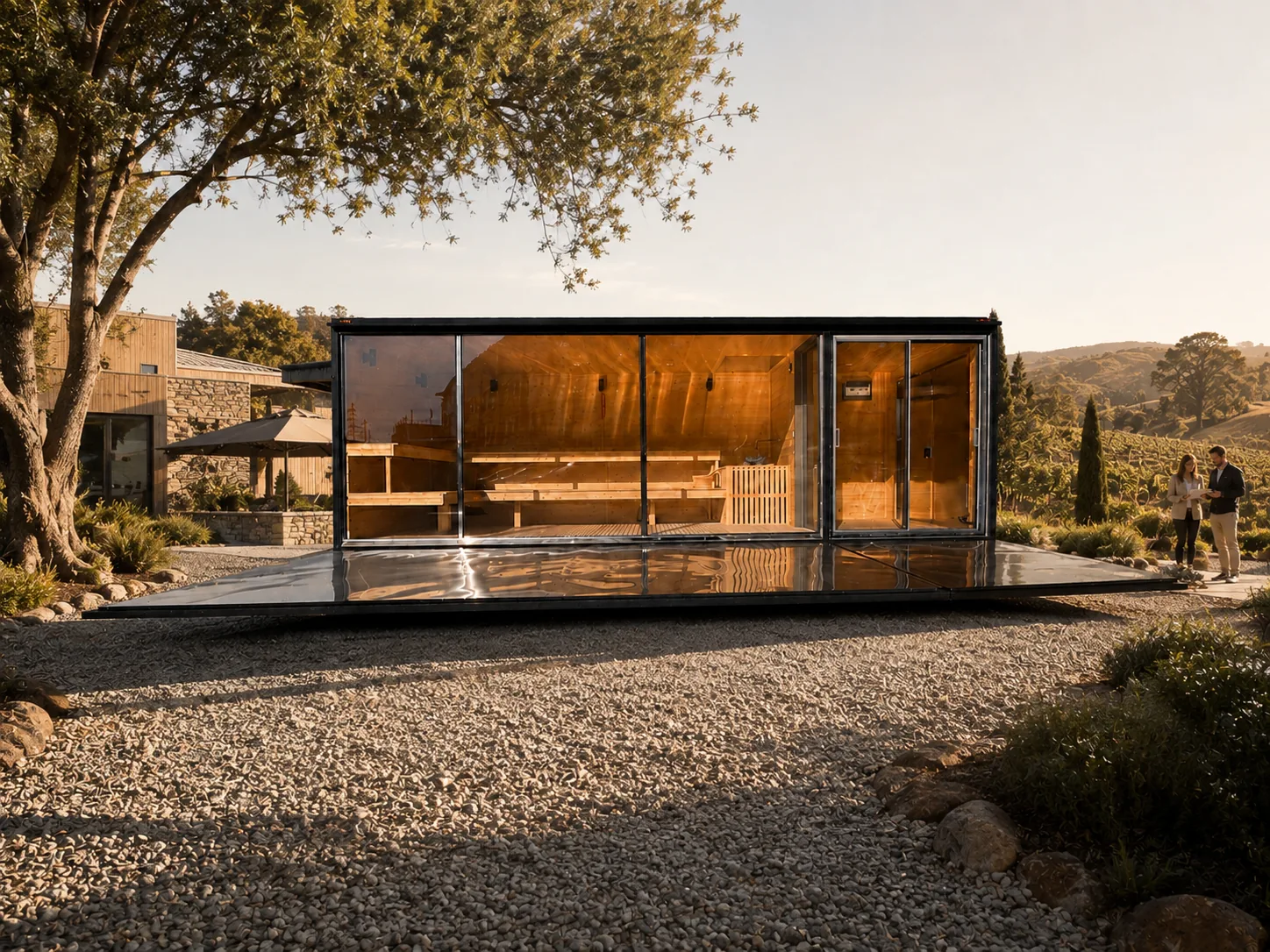
A useful commercial mobile sauna brief defines the business outcome, guest group, site conditions, operating model, access and service constraints, approval responsibilities, evidence required from suppliers and the decision process. It should not begin with an assumed model or an invented specification. Start with the problem the venue wants to solve, attach verified site information, identify unresolved risks, and require suppliers to state assumptions and exclusions clearly.
Commercial sauna projects often become difficult for a simple reason: the buyer, site team and supplier are answering different questions. A venue may be thinking about a new guest experience. The facilities team may be thinking about access, electrical capacity and maintenance. The operator may be thinking about bookings, cleaning and supervision. A supplier may be asked for a price before any of those constraints are clear.
A written project brief brings those streams together. It does not replace design, engineering, local-government, electrical, plumbing, fire, accessibility, workplace-safety, insurance or legal advice. It creates a shared starting point so specialists can respond to the same facts.
1. State the commercial outcome before describing the equipment
Begin with one paragraph that explains why the venue is considering a sauna or recovery system. The answer may be to add a bookable wellness experience, improve an accommodation package, support a gym membership proposition, create a relocatable event asset or test a new operating concept. Avoid vague goals such as “add wellness”.
Record the intended users, likely operating periods, ownership model and the decision the brief is meant to support. Is the venue asking for a feasibility response, a budget range, a fully documented proposal or a final quotation? These are different stages.
The Australian Government’s market-research guidance recommends examining customers, products, competitors, location and industry conditions rather than relying on enthusiasm alone. Translate that into evidence questions:
- Which guest or member segment is the experience intended for?
- What problem or desired experience does it address?
- What evidence suggests demand exists?
- What would cause the project to stop or change direction?
- What result would justify moving from concept to detailed design?
2. Describe the venue and operating context
Give suppliers enough context to understand how the system will fit into the wider business. Include the venue type, trading pattern, peak periods, staffing model, guest journey, nearby amenities and whether the asset may move between sites.
For a winery or accommodation venue, explain how guests would discover, book, arrive, change, use the sauna, cool down and return to the main experience. For a gym or sports club, explain who controls access, how sessions interact with training schedules and whether the service is supervised. For an independent wellness operator, identify storage, transport, set-up, booking and cancellation assumptions.
Do not publish customer names, confidential financial information or unverified partnership claims. A supplier brief can contain confidential material, but the public marketing page should only contain facts the owner has approved.
3. Attach verified site facts
A useful site appendix is factual, dated and visual. It may include a dimensioned plan, photographs, approach route, turning areas, surface condition, slope, drainage observations, nearby structures, property boundaries, existing services and the proposed guest path. Mark every unverified item as an assumption.
The brief should ask the venue’s competent advisers to confirm:
- legal site control and any landlord or strata conditions;
- local planning and building requirements;
- vehicle and delivery access, including height, width, gradient and turning constraints;
- stable placement or support requirements;
- safe separation from traffic, vegetation and other hazards;
- electrical supply location, capacity and connection method;
- water, drainage and wastewater arrangements where relevant;
- fire and emergency access;
- accessible approach, information and alternative service arrangements;
- weather exposure, lighting, security and after-hours control.
Link this appendix to the existing commercial sauna site-requirements guide and delivery-readiness checklist rather than repeating every technical question inside the brief.
4. Define the operating model
Describe how the service is expected to run, not just what it should look like. Record proposed session types, booking control, staffing, supervision, cleaning windows, guest screening, incident response, opening and closing duties, maintenance access and records.
The brief should distinguish an aspiration from a requirement. For example, “we are testing 45-minute bookable sessions” is an assumption to validate; it is not a confirmed capacity statement. Exact temperature, capacity, power, weight, cycle time and utility values should come from approved product documentation and site-specific professional advice.
Safe Work Australia’s guidance on managing risks of plant in the workplace treats the full equipment lifecycle as relevant, including installation, commissioning, operation, inspection, maintenance, repair, transport, storage and dismantling. A commercial brief should therefore ask who owns each lifecycle task and what evidence will be handed over.
5. Request comparable supplier responses
Ask every supplier to answer the same headings. This makes differences visible and reduces the chance that a low headline price hides major exclusions.
- Proposed format and why it fits the stated use.
- Approved dimensions, weight, capacity and utility requirements.
- Included equipment, finishes and controls.
- Site preparation and client-supplied works.
- Delivery, placement, commissioning and handover scope.
- Operating, cleaning and maintenance documentation.
- Warranty scope, exclusions and service arrangements.
- Evidence for any compliance, performance or benefit claims.
- Assumptions, exclusions, dependencies and validity period.
- Programme, milestones, payment stages and change-control process.
Where information is still unknown, require a provisional allowance or a clearly labelled dependency. Do not let a proposal silently assume ideal access, unlimited power, simple approvals or a ready site.
6. Use a responsibility matrix
A simple responsibility matrix can prevent expensive gaps. List each workstream and nominate who is responsible, who approves, who must be consulted and who needs to be informed. Typical workstreams include site survey, planning, building classification, electrical design, plumbing, fire planning, accessibility review, insurance, traffic management, ground preparation, delivery, commissioning, staff training, cleaning, fault reporting and maintenance.
The matrix should use roles, not just people’s names, so it remains useful when staff change. Any unresolved responsibility should be visible before contract signature.
7. Set evidence and claims rules
Specify what evidence the buyer expects before accepting important statements. This may include product drawings, manuals, certificates, licences, test reports, photographs of the actual system, warranty terms and references that the venue is permitted to contact.
The ACCC’s advertising guidance says claims should be true, accurate, based on reasonable grounds and capable of proof. Apply that discipline to both the procurement process and the eventual marketing. Do not treat concept imagery as a completed installation, a forecast as a result, or a supplier statement as an independent approval.
8. Define the commercial evaluation method
Price matters, but a decision-ready brief also explains how proposals will be assessed. Possible weighted criteria include fit for purpose, site compatibility, operating simplicity, evidence quality, lifecycle support, guest experience, accessibility, risk allocation, delivery confidence and total cost.
Do not publish a universal weighting. A winery may place more emphasis on guest journey and site presentation, while a touring operator may prioritise movement, set-up and storage. Record the weighting before final proposals arrive so it does not shift to favour a preferred presentation.
Include a “clarifications” stage. Suppliers should be able to identify contradictions, propose alternatives and explain where professional advice is required. A disciplined clarification log is more reliable than decisions scattered across emails and calls.
9. Build a decision gate, not an automatic purchase
The brief should end with a decision gate. A responsible result may be proceed, revise, pilot, seek more evidence or stop. Define the minimum evidence for each outcome.
A pilot can test demand, booking behaviour, turnaround, staffing, noise, privacy and guest communication, but it cannot bypass approval, safety or technical obligations. If the project proceeds, preserve the assumptions register and convert it into the commissioning and operating handover.
Common mistakes in a commercial sauna brief
- Requesting a fixed price before the site and scope are understood.
- Copying another venue’s specifications without checking the local context.
- Treating a trailer format as automatically exempt from planning or building requirements.
- Mixing forecasts, targets and verified results in the same table.
- Omitting client-supplied works, delivery access or commissioning responsibilities.
- Accepting marketing claims without asking for evidence and limitations.
- Ignoring cleaning, maintenance, downtime and replacement planning.
- Leaving the operator, facilities team, insurer or approving authority out of early discussions.
Minimum brief template
Use these headings in a first draft:
- Project purpose and decision required.
- Venue, audience and operating context.
- Proposed experience and guest journey.
- Site plan, access and verified constraints.
- Utilities and client-supplied works.
- Approval and professional-advice workstreams.
- Operational, safety and accessibility requirements.
- Required supplier response format.
- Evidence, documentation and handover requirements.
- Commercial evaluation, programme and decision gates.
Mobile Sauna Systems can use a completed brief to frame an initial commercial discussion. The supplier response still needs to be checked against the actual site, approved product information and the advice of relevant authorities and competent professionals.
Frequently asked questions
What should I send before requesting a mobile sauna proposal?
Send the business objective, venue type, intended users, proposed location, site photographs, measured access information, known utility details, operating assumptions and the decision you need the proposal to support. Clearly label anything that has not been verified.
Should a project brief specify the exact sauna model?
Only when an approved model has already been selected for sound reasons. Early briefs are usually stronger when they describe outcomes and constraints, allowing the supplier to explain which format fits and why.
Who should approve the brief?
The business owner or sponsor, operator, facilities or site representative and relevant advisers should review the sections they own. The required professional and authority involvement depends on the site and project.
Can the supplier manage every approval?
Do not assume so. The responsibility matrix should show which approvals and professional services are included, excluded or dependent on the venue, landlord, authority or another consultant.
How do I compare proposals fairly?
Issue the same brief, require the same response headings, record clarifications and compare total scope, evidence, exclusions, lifecycle support and site fit—not only the headline price.
What is the next step after the brief is approved?
Use it to request a structured feasibility response or proposal, resolve assumptions, commission site-specific advice and move through a documented decision gate. To discuss your brief, start a commercial enquiry or call 0432 394 901.
Sources and limitations
- Australian Government — Do market research
- Australian Government — Develop your business plan
- Safe Work Australia — Managing risks of plant in the workplace
- Australian Competition and Consumer Commission — Advertising and promotions
This is a planning framework, not legal, engineering, approval, financial, medical or insurance advice. Requirements depend on the product, site, use, jurisdiction and operating model.
Plan your commercial system
Start with your venue, audience and operating goal.
Tell Mobile Sauna Systems about the proposed site and commercial opportunity so the right questions can be framed for a qualified project discussion.
This article provides general information only and is not medical, legal, planning, engineering or financial advice. Requirements vary by project and jurisdiction. Seek appropriately qualified advice for your circumstances.