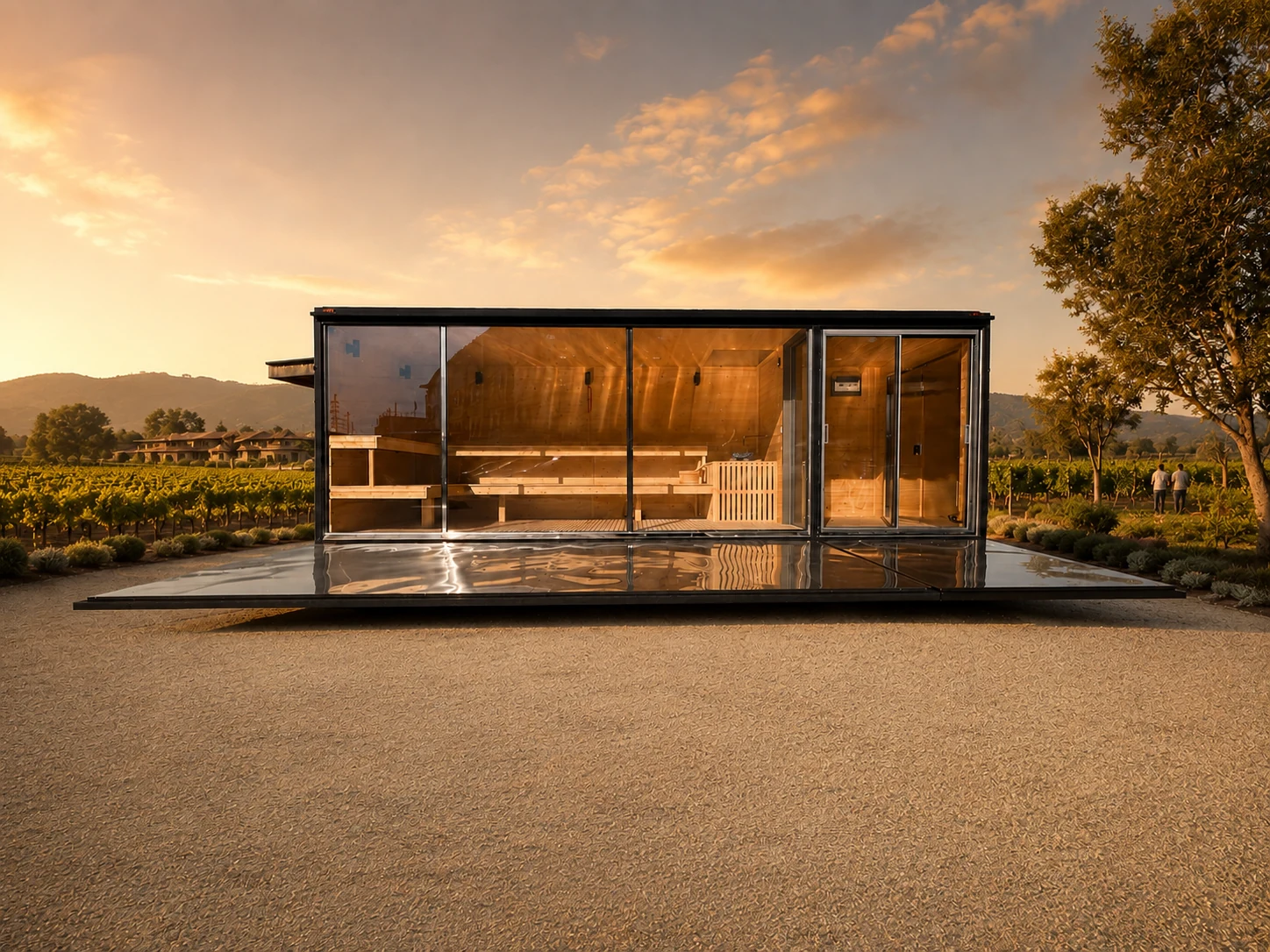
A winery, resort or accommodation venue should plan a mobile sauna as a complete guest experience, not a standalone room. Define the target guest and offer, map arrival-to-departure flow, confirm site access and services, set staffing and cleaning procedures, check the project-specific approval pathway, and measure paid uptake, contribution, guest feedback and operational load before expanding.
A relocatable sauna or recovery pavilion can give a hospitality property a distinctive experience, but the commercial result depends on how well it fits the venue. The strongest concept supports the location, brand, guest itinerary and operating team. It should not feel like equipment placed in an unused corner.
This guide is designed for Australian wineries, resorts, boutique accommodation providers and tourism venues considering sauna, red-light or cold-plunge elements. It offers a planning framework, not a promise of revenue, planning approval, wellness outcome, delivery time or guest demand.
It expands the venue applications introduced in the Mobile Sauna Systems commercial overview and helps teams prepare a more useful project enquiry.
Choose the guest before the format
Describe one primary guest group and the occasion for use. Examples might include couples staying for a weekend, small groups attending a retreat, conference delegates adding a private recovery session, or local members attending a scheduled evening programme.
Avoid the phrase “everyone who likes wellness.” Different groups need different booking rules, session times, privacy, supervision and price structures. A concise guest statement should answer:
- Who is the experience primarily for?
- What are they doing immediately before and after it?
- Are they staying on the property or visiting for the day?
- Do they book privately, join a shared session or receive it in a package?
- What information and facilities do they need to participate confidently?
- Which staff team owns the guest relationship?
The first concept does not have to serve every possible market. A focused offer is easier to operate and measure.
Define the venue role
A winery may want a reason to extend a regional itinerary or create a bookable private experience. A resort may want a paid activity that complements accommodation. A small property may want a compact destination feature without redesigning a whole building. A retreat venue may need a controlled element within a facilitated programme.
Write the role in one sentence. For example: “A bookable, supervised private sauna experience for adult overnight guests in late afternoon.” That sentence shapes capacity, operating hours, location, staffing and the booking journey.
Do not make health-treatment claims to make the role sound more valuable. Describe the experience accurately and let qualified health guidance, where relevant, sit outside the commercial promise.
Map the full guest journey
Start the map before arrival. The guest should understand what they are booking, what is included, what to bring, arrival time, participation conditions and how to ask questions.
At the venue, trace these moments:
- Signage and wayfinding from car park, room or reception.
- Check-in and confirmation of the correct booking.
- Storage, changing and access to toilets or showers where applicable.
- A clear session briefing and opportunity to decline or stop.
- Safe, private movement into the sauna.
- Cooldown and any adjacent recovery element.
- Water, towel and waste handling.
- Departure without colliding with the next group.
- Staff reset, cleaning, inspection and issue recording.
Run the map in rain, after dark and during the busiest venue period. A vineyard path that is delightful at sunset may need lighting, drainage and an alternative route in winter. A resort location near rooms may create privacy or noise concerns during early and late sessions.
Place the system where it helps the experience
Views and visual impact are valuable, but placement must also work for delivery, services and staff. Screen several sites before committing to a render.
Review:
- delivery, towing or lifting access;
- stable placement and drainage;
- electrical and other service routes;
- distance from reception, accommodation and amenities;
- guest privacy and outlook;
- accessible movement objectives;
- weather exposure, shade and prevailing wind;
- emergency and maintenance access;
- neighbouring rooms, residences or venue activities; and
- future landscaping or development that could block movement.
Use an annotated aerial image and ground-level photographs. Mark every unverified dimension. Have the selected route and site assessed by the relevant transport, design, trade and authority professionals.
Select trailer, pavilion or fixed integration
A road-towable trailer can suit pop-ups, events or a model shared between partner venues. Frequent movement must be designed into staffing, towing, setup, storage and road-vehicle obligations. A relocatable pavilion can provide a more architectural destination presence and move occasionally by specialist transport. A fixed sauna can integrate with permanent amenities when the location and demand case are long term.
Use movement frequency as the first filter. Then compare guest capacity, premium presentation, service access, setup time, approval pathway, staff workload, weather resilience and whole-of-life cost. Require each option to state its transport and placement method.
If a road-towable trailer is proposed, consult the Australian Government’s road-vehicle standards information. Trailers may need an approval pathway and entry on the Register of Approved Vehicles before first supply, with state or territory registration requirements also relevant.
Plan services and adjacent recovery elements
Obtain project-specific equipment information before confirming power. In Western Australia, electrical work must be carried out by appropriately licensed people. A licensed electrical contractor should assess the site supply, connection, protection, isolation and documentation needs for the proposed equipment.
If red-light or cold-plunge elements are included, give each a separate scope. Confirm power, water, drainage, cleaning, supervision, maintenance and fault procedures. Avoid describing a collection of products as an integrated recovery system until the interfaces and responsibilities are documented.
Plan towels, drinking water, laundry, waste and cleaning storage. Hospitality teams notice operational friction quickly; involving them early can prevent a design that looks excellent but adds impractical daily tasks.
Design the booking offer
Decide whether sessions are private, shared, packaged or event-based. Each model needs clear capacity, length, changeover, inclusion, cancellation, late-arrival and supervision rules.
Private sessions
Private sessions can suit couples, small groups or premium accommodation packages. The model may improve privacy but can reduce paid places per operating hour if attendance is low. Model the actual average group size.
Shared scheduled sessions
Shared sessions can make capacity available to more guests, but they require precise guest information, conduct rules and a comfortable social design. Do not assume all hotel guests want to share a sauna.
Accommodation or event packages
Packages can simplify the guest decision, but revenue attribution must be clear. Decide how the sauna component is valued, what happens when it is unavailable and whether the booking system prevents over-allocation.
Partner-operated experience
A specialist operator may bring booking and facilitation capability, while the venue provides the site and audience. Document responsibilities for staff, maintenance, insurance, guest communication, refunds, data, opening decisions and incident response.
Test a pilot without pretending it is proof
A limited pilot can test demand and operations before a wider rollout. Define the pilot period, available sessions, audience, price, marketing channel and success criteria in advance. Ensure the pilot itself follows the relevant site, safety and authority requirements.
Measure:
- available and paid places;
- realised price and contribution per session;
- booking source and package uptake;
- cancellations and no-shows;
- staff minutes per session;
- cleaning and reset time;
- downtime and faults;
- guest questions and feedback themes; and
- effect on other venue operations.
A waitlist or social-media response can indicate interest, but it is not completed paid demand. A short successful weekend does not prove year-round utilisation. Record season, weather, promotion and event context.
Protect the core venue experience
The sauna should not compromise accommodation quiet, winery service, housekeeping workload or event logistics. Set operating hours around the venue rather than copying another operator’s timetable.
Assign operational ownership. Reception may manage bookings, but another person may be responsible for inspection and opening. Housekeeping may handle towels but not equipment faults. A manager may decide weather closure. Put the roles in a simple responsibility table and provide escalation contacts.
Test the handover between teams. Many service failures happen between booking, operations and maintenance rather than inside the sauna room.
Measure commercial value honestly
Use direct measures before broad brand claims. Track session contribution, paid occupancy, repeat bookings, package uptake, referral sources and operating cost. For accommodation, compare relevant booking or stay measures cautiously and avoid assuming causation from a simple before-and-after change.
Define a review cadence. During launch, weekly review may be appropriate; once stable, monthly may be enough. Record decisions, such as changing session times or pausing a low-demand offer, so the business learns rather than merely accumulates numbers.
Do not promise that the experience will increase occupancy, wine sales, length of stay or media coverage. Treat those as hypotheses to test with suitable data.
Content and partnership opportunities
A venue can create useful evidence without making exaggerated claims. With permission, document the planning process, site-selection criteria, guest-flow decisions, operating checklist and pilot results. Original photographs, verified specifications, responsible expert commentary and an honest case study are more valuable for trust than generic lifestyle content.
Potential industry pathways include venue and supplier organisations, regional tourism bodies and wellness or fitness associations. Check eligibility, cost and editorial rules before applying. An Australian Tourism Data Warehouse listing is aimed at eligible tourism operators providing a direct leisure-tourism product; a supplier-only business may not meet the criteria. Do not submit a listing merely to obtain a link.
Common venue-planning mistakes
- Starting with an Instagram location before checking access and services.
- Designing for maximum capacity rather than the target guest and session.
- Putting booking, cleaning and fault responsibility across several teams with no owner.
- Assuming a movable system has no local approval considerations.
- Bundling sauna, red-light and plunge components without defining interfaces.
- Forecasting full sessions from launch.
- Calling concept imagery a completed venue installation.
- Measuring likes and enquiries without paid uptake or operating effort.
- Ignoring the effect on reception, housekeeping, events and neighbours.
A staged decision path
First, approve the guest and venue-role statement. Second, screen sites and formats. Third, confirm likely authority, service and transport pathways. Fourth, compare written scopes and whole-of-life costs. Fifth, design the booking and staffing model. Sixth, complete project-specific assurance and handover. Seventh, run a measured pilot where appropriate. Finally, expand only when guest demand and operating performance support the next step.
This sequence keeps the experience ambitious and the decisions evidence-led.
Frequently asked questions
Is a mobile sauna suitable for a winery?
It can be, if the experience fits the winery’s audience, site, trading pattern and responsibilities. Check access, services, guest movement, privacy, staffing, relevant approvals and the relationship with wine service. Do not assume suitability from the setting alone.
Should a resort choose a trailer or relocatable pavilion?
A trailer suits planned road movement; a pavilion can suit a premium destination presence with occasional relocation. Compare movement frequency, guest integration, services, transport, authority pathway, operating effort and total cost for the resort’s site.
How can accommodation providers price sauna sessions?
Model private, shared and packaged offers using actual capacity, expected paid attendance, session length, changeover, variable costs and venue overheads. Test conservative scenarios and seek financial advice rather than copying a price from a different market.
What should staff do between sessions?
The venue’s documented procedure should cover guest departure, ventilation or reset steps specified for the system, cleaning, towels and waste, visual inspection, issue recording and readiness for the next booking. Assign responsibilities and required training.
Can a venue list a sauna experience on tourism platforms?
Eligibility depends on the platform and actual product. Australian Tourism Data Warehouse guidance focuses on tourism operators providing a direct leisure-tourism service and excludes some virtual or supplier-only businesses. Check current criteria and submit only accurate, eligible information.
Plan your commercial system
Start with your venue, audience and operating goal.
Tell Mobile Sauna Systems about the proposed site and commercial opportunity so the right questions can be framed for a qualified project discussion.
This article provides general information only and is not medical, legal, planning, engineering or financial advice. Requirements vary by project and jurisdiction. Seek appropriately qualified advice for your circumstances.