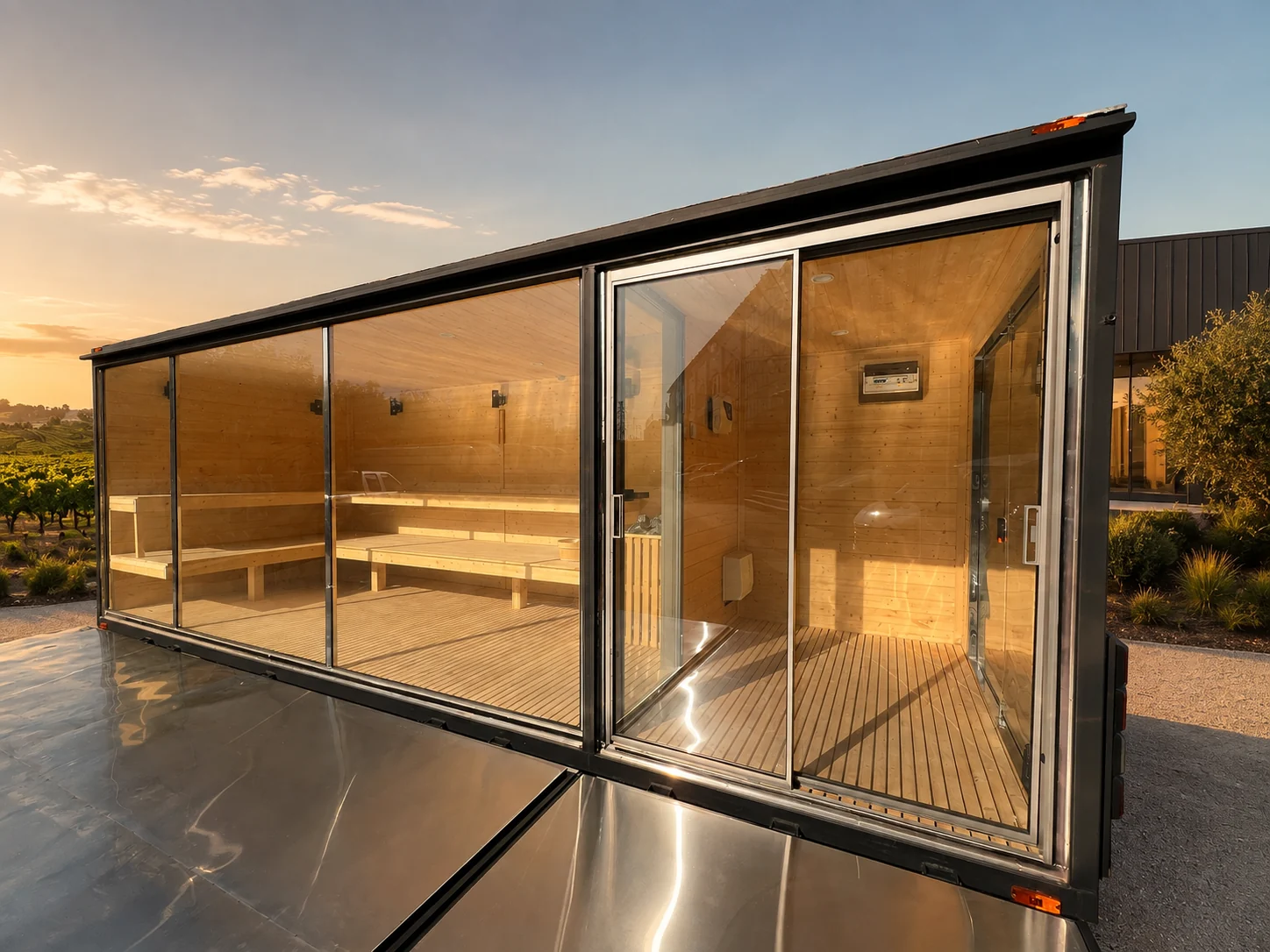
There is no single universal “mobile sauna approval” for every Western Australian project. The pathway depends on what the unit is, where it will operate, how long it will remain there, whether it is supplied as a road vehicle, the services it connects to and how the public will use it. Treat planning, landowner consent, building or public-building questions, road-vehicle status, electrical work, workplace safety, insurance and business licences as separate checks. Confirm each one in writing with the relevant authority or qualified adviser before ordering, placing or opening the system.
A relocatable sauna can look simple because it arrives largely complete. That does not automatically make the site or operation exempt from approvals. A winery, resort, gym, sports club or wellness operator still needs to understand the proposed activity, the physical site, the unit’s legal format and the venue’s responsibilities.
This checklist is a briefing tool, not legal, engineering, planning or electrical advice. Requirements vary between local government areas and projects. Use it to organise conversations and retain evidence, then obtain project-specific decisions from the authorities and professionals responsible for your site.
For the broader physical assessment, read the commercial sauna site requirements guide. For format selection, compare a trailer, relocatable pavilion and fixed sauna.
Begin with an approval brief
Authorities can only give useful guidance when the proposal is clear. Prepare a two-page brief before asking whether approval is needed. Include the site address and lot details, the current land use, the proposed location on a marked site plan, the operating entity, intended opening hours, maximum session size, staff supervision, frequency of relocation and the expected length of each placement.
Describe the system without relying only on the word “mobile”. State whether it is a registered road-towable trailer, a unit moved by specialist transport, a relocatable pavilion or another format. Record its proposed dimensions, mass and service needs only where those figures have been verified by the supplier. Include access, parking, change facilities, toilets, paths, lighting, screening, drainage and any cold-plunge or red-light component.
Label unknowns honestly. An unresolved item is a question to close, not an assumption to bury. This approach helps a planner, insurer, electrician or risk adviser distinguish the equipment from the land use and operating activity.
Map the approval workstreams separately
The phrase “approved sauna” can incorrectly combine several different decisions. Use a register with one row for every workstream, the responsible party, the evidence required, the date requested and the written outcome.
Landowner and lease consent
Confirm that the landowner and, where relevant, the landlord or head lessor accepts the proposed use, location, access arrangements, service connections and reinstatement obligations. A venue manager’s verbal approval may not satisfy a lease, insurer or property owner.
Ask who owns site works, who is responsible for damage, what happens when the unit moves and whether the lease restricts external structures, public activities, signage, noise, traffic or new services. Retain signed consent and the marked plan it refers to.
Local planning and land-use questions
Contact the relevant local government planning team with the approval brief. Ask whether the proposed activity is already covered by the current approval, requires development approval, needs a change or intensification of use assessment, or triggers conditions about parking, hours, amenity, access, landscaping, heritage, bushfire or environmental matters.
Do not ask only whether a trailer can be parked on the land. The relevant question is usually broader: may this commercial, guest-facing activity operate in this place under the proposed conditions? A system that can move may still function as part of the venue for a sustained period.
Building, accessibility and public-use questions
Ask the local government or appropriately qualified building professional whether the system, platform, stairs, ramps, balustrades, change area, shelter or associated works trigger building or occupancy requirements. Confirm how guests enter and exit, how emergency egress works and what accessibility obligations or reasonable design objectives should shape the complete visitor journey.
The answer can depend on the arrangement, not just the sauna enclosure. A temporary deck, fixed connection, enclosed waiting area or new path may introduce separate issues. Keep drawings version-controlled so that a decision about one layout is not mistakenly applied to a later layout.
Business licences and activity-specific permits
The Australian Government explains that licences and permits depend on the business type, activities, state or territory and local government area. Use the Australian Business Licence and Information Service as a starting point, then verify the result with the relevant authorities.
A sauna offer attached to accommodation, alcohol service, an event, a public venue or another regulated activity can interact with existing venue conditions. Record whether the experience is sold separately, packaged with another service or operated by a third party. That distinction may affect responsibilities and insurance.
Check road-vehicle status without assumptions
If the unit is supplied or moved as a trailer, separate first-supply approval, registration and on-road movement from permission to operate at the destination. The Australian Government states that low-ATM trailers—those with an aggregate trailer mass of 4.5 tonnes or less—need an approval pathway before being provided to the Australian market and must have compliance information on the Register of Approved Vehicles before first supply. Its low-ATM trailer guidance also points to applicable Australian Design Rules and Vehicle Standards Bulletin 1.
Do not infer that a particular Mobile Sauna Systems unit falls inside or outside that category until verified mass, design and approval evidence is available. Ask the supplier for the VIN or vehicle identity information, RAV evidence where applicable, aggregate trailer mass, towing requirements and any movement limitations. Confirm registration and road-use requirements with the relevant state authority.
For units moved by crane or specialist transport, document lift points, transport responsibility, route constraints, permits where applicable and the competent parties involved. “Relocatable” describes an operational advantage, not a complete legal or logistics method.
Treat electrical work as its own controlled package
Start with a verified load and connection schedule, not “a power point should be enough”. Record the heater, controls, lighting, ventilation and other equipment, the proposed connection method, protection, cable route, isolation, exposure to weather and any other loads operating at the site.
The Western Australian Government states that electrical installation work must be carried out by appropriately licensed people. Its electrical licensing guidance explains that electrical contractors and electricians are regulated under WA requirements. Engage a licensed electrical contractor to assess the actual site and final equipment package.
Ask who designs the connection, who supplies any distribution or cabling, what certificates or test records will be provided, what the venue must maintain and what is disconnected before relocation. Keep manufacturer documentation with the final site records. A certificate for one part of the system does not approve the entire business operation.
Build the venue risk and operating file
Safe Work Australia’s model risk-management code uses a practical cycle: identify hazards, assess risks where necessary, control risks and review the controls. The applicable law and regulator must be checked for Western Australia, but the method is a useful operating discipline.
For a guest-facing sauna, consider heat exposure, slips, surfaces, glass, electrical interfaces, staff tasks, cleaning products, manual handling, lone work, emergency communication, weather, children, intoxication policies, health screening language and transitions to any plunge area. The control plan should explain supervision, guest information, exclusion or escalation rules, cleaning, inspections, incident response and review.
Avoid turning a blog or supplier manual into medical clearance. Establish the venue’s policy with appropriate health and legal advice, communicate limitations clearly and direct guests with health concerns to a qualified health professional. Do not promise a therapeutic outcome that has not been substantiated.
Use a decision register, not a yes-or-no checklist
For every workstream, record:
- the precise question asked;
- the authority, adviser or contractor consulted;
- the site plan, drawing or specification version supplied;
- the written answer and any conditions;
- the person responsible for satisfying each condition;
- the evidence required before opening;
- the renewal, inspection or review date; and
- what change would trigger reassessment.
An answer such as “no permit required” is only useful when it identifies the proposal and the authority that gave the answer. Keep emails, letters, approved drawings, certificates, insurance endorsements, risk documents and operating procedures together in a controlled project folder.
Stage the project around approval gates
A practical sequence is:
- Define the operating model and candidate site.
- Obtain an indicative system scope and verified information needed for assessment.
- Complete landowner, planning and building pathway enquiries.
- Confirm road-vehicle or relocation evidence for the selected format.
- Obtain site-service advice from licensed trades.
- Confirm insurance and contractual responsibilities.
- Finalise drawings, guest flow, risk controls and operating procedures.
- Complete installation, testing, documentation and staff training.
- Open only after all project-specific conditions and evidence are closed.
Avoid paying irreversible site-work or launch costs before the relevant gates are understood. A supplier can support the evidence package, but the venue remains responsible for confirming what applies to its land, activity, staff and guests.
Common approval mistakes
- Assuming “mobile” means planning, building or operating requirements cannot apply.
- Treating road registration as permission to trade at a site.
- Asking an authority about an incomplete or different layout, then relying on the answer after the design changes.
- Connecting equipment before a licensed contractor has assessed the actual supply and installation.
- Accepting a broad “compliant” statement without identifying the standard, scope, evidence and responsible party.
- Forgetting associated works such as decks, paths, drainage, screening, lighting and plunge equipment.
- Launching marketing before insurance, staff procedures and emergency arrangements are confirmed.
- Copying another venue’s approval pathway when the land use, council, system or operating model differs.
Measure approval readiness
Track the percentage of workstreams with written outcomes, the number of open conditions, evidence still due, dependencies on third parties and changes awaiting reassessment. Do not use an arbitrary “90% approved” label if the remaining item could prevent opening.
The stronger go-live measure is binary: every critical condition has an owner, acceptable evidence and a closed status. Keep a separate post-opening calendar for inspections, maintenance, staff refreshers, incident reviews, licence renewals and any conditions requiring ongoing records.
Frequently asked questions
Does a mobile sauna in WA always need council approval?
Not always, and not never. The outcome depends on the site, land use, physical works, length and pattern of placement, guest activity and local requirements. Give the relevant local government a clear written proposal and retain its project-specific response.
Is trailer registration enough to operate commercially?
No. Trailer or road-vehicle compliance relates to supply, registration or movement. The destination may involve separate landowner, planning, building, electrical, workplace, insurance and business requirements.
Who can do the electrical connection in Western Australia?
Electrical installation work must be handled by appropriately licensed people under Western Australian requirements. Ask a licensed electrical contractor to assess the final equipment and actual site, and retain the required certificates or test records.
What information should I request from a supplier?
Request verified dimensions and mass, format and relocation method, applicable vehicle evidence, drawings, equipment and load schedule, installation assumptions, exclusions, manuals, maintenance requirements, commissioning scope and the exact evidence supporting any compliance statement.
Can Mobile Sauna Systems approve my site?
Mobile Sauna Systems can help frame system and site questions, but it cannot replace the decisions of local authorities, licensed trades, insurers, engineers, building professionals or other qualified advisers responsible for your project.
Sources and further checks
Plan your commercial system
Start with your venue, audience and operating goal.
Tell Mobile Sauna Systems about the proposed site and commercial opportunity so the right questions can be framed for a qualified project discussion.
This article provides general information only and is not medical, legal, planning, engineering or financial advice. Requirements vary by project and jurisdiction. Seek appropriately qualified advice for your circumstances.