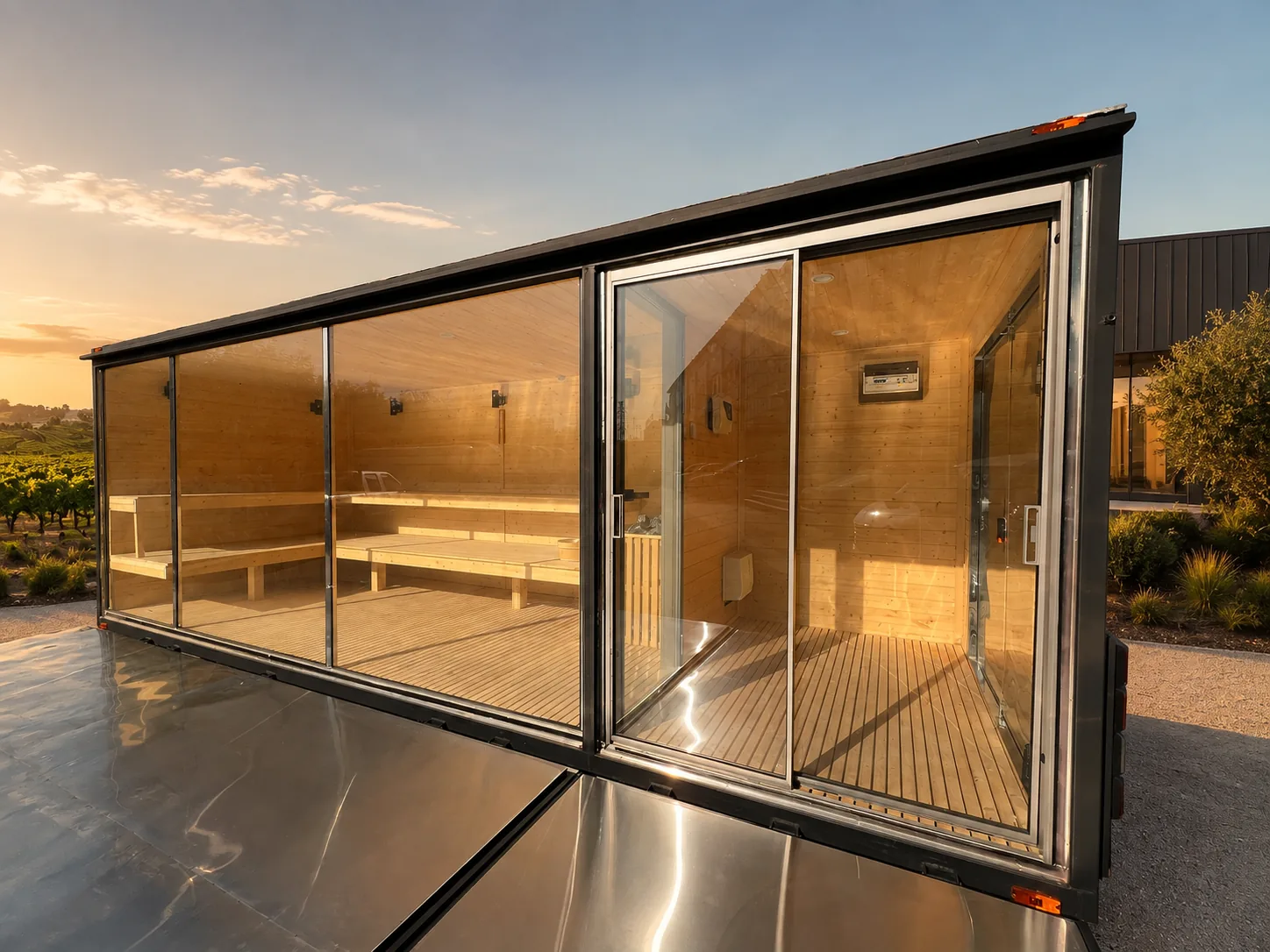
A useful commercial mobile sauna quote defines the exact system, evidence, delivery boundary and buyer responsibilities. It should identify the configuration being priced, what is included and excluded, which facts are confirmed or provisional, who handles transport and site work, what acceptance evidence is supplied, how variations are approved, and what happens if the delivered system differs from the agreed scope. Compare quotes line by line rather than comparing headline totals.
Commercial sauna proposals often use the same broad labels while covering very different work. “Turnkey”, “mobile”, “commercial grade” and “ready to operate” are not complete scopes. The buyer still needs to know which structure, trailer or relocatable base, heating equipment, controls, glazing, ventilation, electrical work, finishes, documentation, freight, installation and after-sales support are actually included.
This guide is general procurement planning. It is not legal, engineering, electrical, building, vehicle-compliance, tax, customs, financial or insurance advice.
Start with one controlled buyer brief
Issue the same written brief to every shortlisted supplier. State the proposed venue, use case, operating environment, expected session pattern, location, movement plan and current site facts. Separate requirements from preferences so a supplier can identify genuine conflicts rather than quietly pricing a different concept.
Use the commercial mobile sauna project brief to define the decision before requesting prices. Include the questions that affect suitability: permanent or relocatable use, likely travel, site access, exposure, guest flow, supervision, cleaning, utilities, accessibility and the intended commercial model.
Ask each supplier to return a compliance matrix against the brief. A simple response of “included” is not enough when a requirement depends on a model, third-party component or site condition. The response should point to the drawing, specification, test document, allowance or exclusion that supports it.
Identify the exact quoted configuration
The quote should name or uniquely identify the configuration. Record drawing revision, layout, external dimensions, stated weights, seating layout, door and glazing arrangement, structure, chassis or base, heater and controls, lighting, ventilation, finishes and optional equipment. Treat these as provisional unless the supplier provides approved evidence for the exact system being offered.
Do not combine specifications from a display unit, brochure and custom proposal without a written reconciliation. A component shown in a photograph may not be included. A capacity claim may use a different seating layout. A heater option may change utility requirements. Ask which document controls if descriptions conflict.
Mobile Sauna Systems does not currently publish approved model dimensions, weights, capacities, utilities, delivered prices or warranty terms. Those details must remain buyer-specific and evidence-gated until supplied and approved.
Divide the price into scope packages
Ask for a price schedule that separates the main work packages. A practical structure can include:
- system structure, trailer or relocatable base;
- sauna room lining, benches, floor and protective details;
- heater, stones, controls and guards;
- electrical equipment and factory wiring;
- glazing, doors, seals and hardware;
- ventilation and any mechanical equipment;
- lighting and non-sauna areas;
- cold-plunge or red-light equipment where relevant;
- design, drawings, documentation and certification evidence;
- factory testing and inspection;
- packing, freight, insurance and destination charges;
- unloading, placement, installation and commissioning;
- training, manuals, handover and initial spares; and
- taxes, duties, currency assumptions and contingencies.
This allows two proposals to be normalised. A lower supply price may omit freight, site connections, commissioning or evidence that another supplier includes.
Make exclusions visible
Exclusions are part of the commercial offer and should be as clear as inclusions. Typical buyer-side work may include site investigation, approvals, civil or foundation work, access preparation, electrical supply upgrades, water and drainage, cranage, permits, registration, towing arrangements, fire planning, accessibility works, landscaping, operating staff, insurance and ongoing consumables.
Do not assume these items always apply or are always excluded. Ask the supplier to state the boundary. Where an item is outside the supplier’s responsibility, identify who must complete it and what evidence the supplier needs before proceeding.
The site requirements guide can be used to create a site-work schedule before comparing totals.
Separate confirmed facts from allowances
Use three evidence labels: confirmed, allowance and unresolved. A confirmed item should point to supporting documentation. An allowance should state its amount, assumptions and adjustment method. An unresolved item should state the decision owner and deadline.
This is especially important for freight, exchange rates, customs charges, site works, utility upgrades and custom modifications. A quote that hides these behind “to be confirmed” can create a misleading sense of certainty. The Australian Competition and Consumer Commission says product and service claims, including price, descriptions, shipping and delivery information, should be accurate and based on reasonable grounds.
If a critical cost cannot yet be fixed, use a transparent range or provisional sum with a clear reconciliation method. Do not present a partial supply price as the expected total project cost.
Define delivery and transfer of responsibility
Record the delivery term in plain language. State the collection point, destination, loading responsibility, freight provider, insurance responsibility, customs and import roles, unloading method, storage conditions, access assumptions and the point at which risk or care transfers.
For a road-trailer format, identify who is responsible for the applicable Australian import and vehicle-approval pathway, registration, number plates, towing information and destination requirements. A foreign certificate or road registration should not be treated as automatic Australian acceptance. Use the China factory visit checklist to connect product evidence to the exact quoted configuration.
For a relocatable pavilion, identify lifting, crane, set-down, foundations, tie-downs, service connections and weatherproofing interfaces. The buyer should know when supplier supervision is required and what voids a warranty or acceptance test.
Specify documentation deliverables
Create a document register within the quote. Depending on the project, it may request controlled drawings, equipment schedules, component data, electrical information for the licensed contractor, operating and maintenance manuals, cleaning guidance, inspection records, labels, spare-parts list, warranty process, commissioning records and change history.
Do not state that a document proves compliance unless the responsible adviser has confirmed its scope and relevance. Ask who issued it, which product revision it covers, what standard or test method it refers to, and whether any conditions or expiry apply.
Documentation should be available early enough to influence the decision, not promised only after final payment.
Connect payment to evidence and milestones
A milestone schedule should describe the evidence needed before each payment, not only the calendar date. Examples include approved drawings, confirmed component schedule, manufacturing progress evidence, pre-shipment inspection closure, packing record, dispatch documents, arrival inspection, commissioning and accepted handover.
The correct structure depends on the contract, supplier, jurisdiction and risk allocation. Obtain legal and financial advice before agreeing to deposits, overseas payments, retention, security instruments or refund conditions. The pre-sale readiness guide explains why customer promises should not outrun supplier evidence.
Add variation control
Every change should identify the request, reason, affected drawing or specification, price effect, delivery effect, evidence effect and approval. Verbal changes are difficult to reconcile at factory inspection and handover.
Require the supplier to flag substitutions before they occur. A substituted heater, control, glazing detail, electrical component or trailer part may affect fit, documentation, servicing and acceptance. “Equivalent” should be supported by a written comparison and accepted by the responsible decision-maker.
Keep one current scope register. Superseded versions should remain traceable but must not guide production.
Define acceptance before ordering
Acceptance criteria should cover identity, completeness, visible condition, function, documentation, unresolved defects and support. State which checks occur at the factory, before dispatch, on arrival, after placement and after commissioning.
The handover, warranty and spares checklist provides a structured approach. Critical safety, compliance, function or documentation failures should not be hidden in a general defects list. The contract should explain the process for correction, retesting and final acceptance.
Compare total project exposure
Use a comparison table with more than the quoted total. Include scope completeness, evidence strength, unresolved allowances, buyer-side work, delivery risk, service access, spare-parts support, variation method, payment exposure and acceptance clarity.
Score only what is supported. An unanswered question is not a zero-cost item. Record it as unresolved, assign an owner and include the possible cost or schedule consequence in the decision discussion.
The best-value proposal is the one that most clearly supports the intended use and leaves the fewest unmanaged surprises, not automatically the cheapest or most detailed-looking document.
Common quote-comparison mistakes
- Comparing headline prices before normalising scope.
- Treating “turnkey” as proof that site work and approvals are included.
- Using brochure specifications for a different configuration.
- Ignoring freight, unloading, commissioning, tax or currency assumptions.
- Accepting verbal inclusions that are absent from the controlled quote.
- Leaving substitutions and variations to supplier discretion.
- Scheduling payments without evidence gates.
- Assuming a foreign certificate answers Australian requirements.
- Accepting vague warranty language without responsibilities or exclusions.
- Signing final acceptance while critical defects or documents remain open.
Frequently asked questions
What should a commercial mobile sauna quote include?
It should identify the exact configuration, inclusions, exclusions, evidence, delivery boundary, buyer responsibilities, payment milestones, variation process, acceptance criteria, warranty pathway and unresolved assumptions.
Is a turnkey quote the same as a complete project price?
Not necessarily. Ask the supplier to define turnkey and list all site, transport, approval, connection, commissioning and operating items outside its scope.
How should two sauna suppliers be compared?
Issue the same buyer brief, normalise both proposals into the same scope packages, label evidence and allowances, then compare total project exposure as well as price.
Should freight and import costs be fixed?
Some costs may remain provisional. If they cannot be fixed, record the basis, allowance, responsibility, timing and adjustment method rather than treating them as included.
What evidence should be supplied before a deposit?
The answer depends on the contract and risk. At minimum, the buyer should understand the supplier identity, controlled configuration, scope, payment terms, refund or cancellation position, delivery assumptions and evidence still outstanding. Obtain professional advice.
How can I request a commercial discussion with Mobile Sauna Systems?
Share the venue, intended use, location and timeframe through the commercial enquiry form or call 0432 394 901.
Sources and limitations
- ACCC — False or misleading claims
- ACCC — Consumer rights and guarantees
- ACCC — Selling products and services
- Department of Infrastructure — Importing a road vehicle into Australia
These sources provide general public guidance. The required documents and responsibilities depend on the transaction, destination, configuration and intended use. Seek qualified legal, engineering, electrical, vehicle, customs, tax and insurance advice where relevant.
Plan your commercial system
Start with your venue, audience and operating goal.
Tell Mobile Sauna Systems about the proposed site and commercial opportunity so the right questions can be framed for a qualified project discussion.
This article provides general information only and is not medical, legal, planning, engineering or financial advice. Requirements vary by project and jurisdiction. Seek appropriately qualified advice for your circumstances.