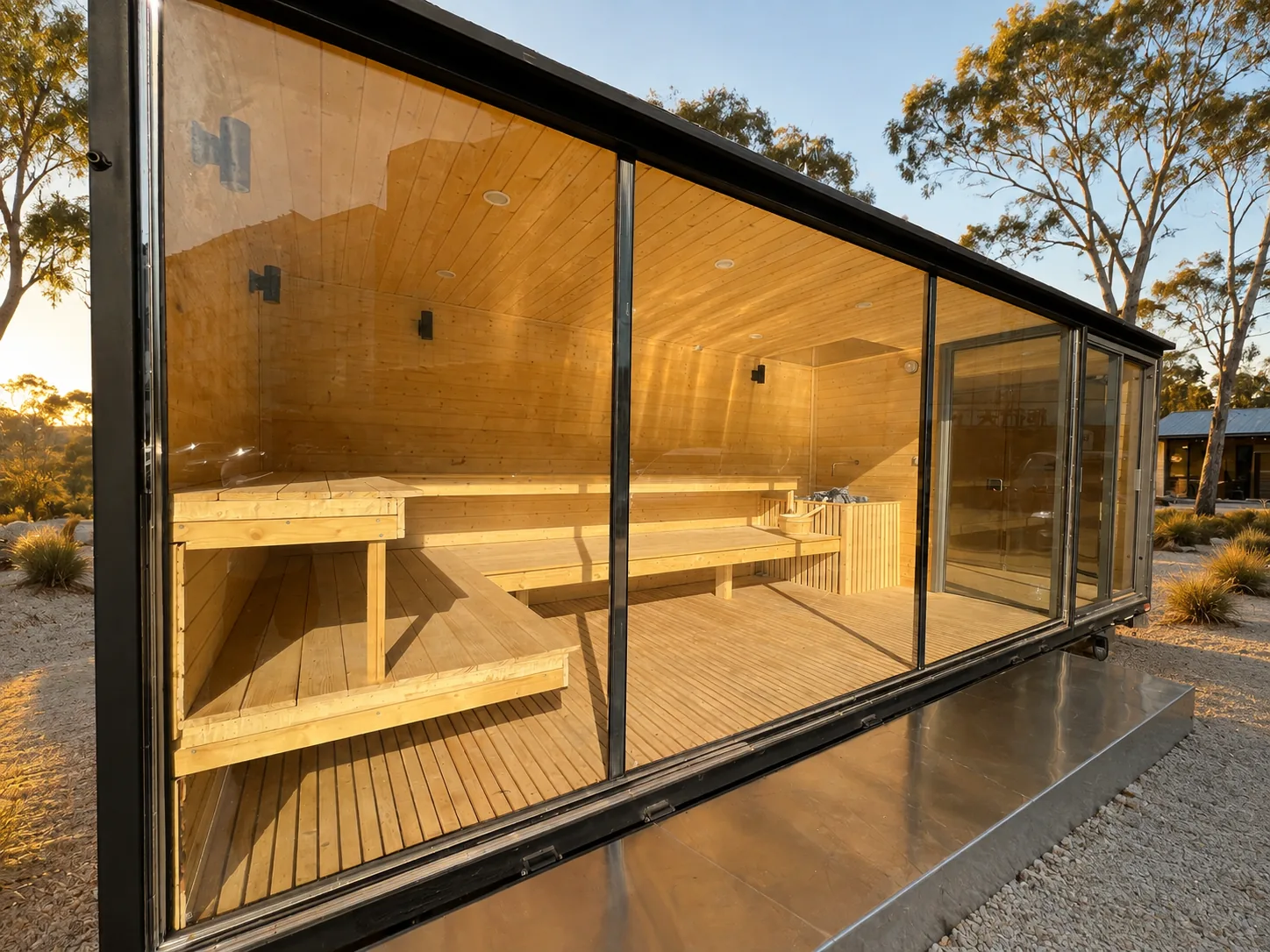
A sports club should assess a mobile sauna or recovery pavilion as an operating system, not a piece of equipment. The feasibility case needs an approved purpose, defined users, controlled access, competent health and safety input, site and utility checks, staffing, maintenance, insurance, evidence rules, a realistic budget and measurable pilot criteria. A recovery label does not establish a medical benefit, and a movable format does not remove site-specific obligations.
Sports organisations often see recovery infrastructure through several lenses at once. Athletes may want a practical post-training option. Coaches may be interested in routine and availability. Management may see a member benefit or new income stream. Facilities staff see services, cleaning, faults and access. The board sees duty, risk and financial commitment.
A feasibility process lets those views meet before the club commits. The aim is not to prove that a sauna must be purchased. It is to determine whether a defined concept can be operated responsibly and whether the evidence supports the next investment stage.
Begin with a governance decision
Define the sponsor, decision owner and approval path. A club-led project may involve the board, chief executive, high-performance staff, facilities manager, medical or allied-health advisers, coaches, athlete representatives, insurer and landlord. Community clubs may also rely on volunteers, councils and shared-facility arrangements.
The Australian Sports Commission’s Game Plan encourages clubs to assess their own environment, identify improvement areas and develop priorities rather than importing another organisation’s solution. Apply that principle here: describe what capability the club wants, the evidence available and what must be learned.
The board should also define its risk appetite and reporting expectations. The Commission’s sport governance risk guidance recommends a framework appropriate to the organisation’s size and context, with a risk register that records threats and treatments. A recovery pavilion should be placed inside that system.
Define who the facility is for
“Athletes” is too broad for design or operations. Identify the user groups, age ranges, competition levels, training schedules, supervision needs and any groups that require exclusion or additional professional advice. Clarify whether access is limited to a high-performance programme, sold to members, made available to visiting teams or offered to the public.
Each access model changes the questions:
- Private team use may be easier to schedule but still needs eligibility and supervision rules.
- Member access requires booking, induction, conduct, cleaning and fault processes.
- Public access creates a wider customer journey, consumer-law and staffing burden.
- Event use adds transport, set-up, temporary-site and crowd-management issues.
Do not use a generic waiver as a substitute for a controlled operating process. Screening, informed instructions, exclusion rules and escalation pathways should be developed with competent health and safety advisers for the actual users and modalities.
Separate the modalities
Sauna, cold-water immersion and red-light equipment have different site, hygiene, supervision, maintenance, evidence and operating requirements. A combined “recovery zone” can be convenient, but it also combines risks.
The Australian Institute of Sport operates a specialist Recovery Centre with multiple modalities, change rooms and professional support. That is useful context, not a template for a community or commercial club. Do not infer that an equipment list proves the same outcome in another setting.
For each proposed modality, record:
- the intended experience and user group;
- the evidence relied on and important limitations;
- required utilities and environmental controls;
- cleaning, water-quality or surface-care process;
- supervision and emergency response;
- consumables, inspection and servicing;
- downtime consequences;
- how claims will be approved before publication.
If the project cannot yet support a combined system, stage the concept. A sauna-only or carefully limited pilot can generate better operational evidence than launching several modalities simultaneously.
Test the site and movement case
A relocatable pavilion may reduce some permanent works and give the club future flexibility. It does not guarantee approval, safe placement or easy movement. Confirm legal site control, planning and building questions, vehicle access, ground conditions, electrical capacity, water and drainage needs, fire and emergency access, accessible approach, privacy, lighting, security and weather exposure.
Map the full route from changing rooms and training areas. Look for conflicts with vehicles, spectators, children, deliveries and emergency routes. Decide where users cool down and hydrate without creating slippery surfaces or crowding.
If the unit will move, assess storage, towing, driver competence, route planning, set-up responsibilities and pre-use checks. The existing trailer versus pavilion versus fixed comparison and delivery-readiness checklist provide useful question sets.
Design the operating day
Write a sample day from first inspection to close. Include unlocking, pre-start checks, warm-up, booking control, user briefing, supervision, cleaning between sessions, breaks, incident handling, end-of-day shutdown and records.
Then test the schedule against the club’s busiest period. Recovery demand may cluster immediately after training. A theoretical daily capacity can be misleading when all users want the same time. Measure peak-window throughput rather than multiplying capacity by opening hours.
Specify who can stop operation. Staff and volunteers need a clear authority to close the facility when there is a fault, unsafe behaviour, unsuitable conditions or missing supervision. Escalation contacts must be current and available during operating hours.
Build the financial case with scenarios
Use conservative, base and stretch scenarios. Separate capital cost, site works, delivery, approvals, professional advice, insurance, training, utilities, cleaning, consumables, routine maintenance, replacement reserves, payment processing, staffing and downtime.
Then model the potential value. It may include direct session income, a premium membership tier, team hire, sponsor support or a broader retention benefit. Do not count the same benefit twice. Do not present a target as guaranteed revenue.
The Australian Government’s budget guidance recommends comparing actual results with budget and updating assumptions when conditions change. A club should therefore define what data it will collect and who will review it.
Choose pilot measures before launch
A useful pilot has a fixed period, controlled user group and decision thresholds. Possible measures include:
- eligible users invited and percentage completing induction;
- bookings, attendances, cancellations and no-shows;
- peak-time utilisation and wait-list demand;
- cleaning and reset time;
- staff or volunteer hours;
- utilities and consumables;
- faults, closures, incidents and near misses;
- user feedback and repeat intent;
- verified income and direct operating cost;
- accessibility barriers and support requests.
The pilot should not be marketed as proof of health or performance outcomes unless the club has suitable evidence and qualified oversight. The ACCC requires advertising claims to be accurate and supportable.
Decide whether to proceed
At the end of feasibility, use a documented gate:
- Proceed to site-specific design and approvals.
- Revise the concept or operating model.
- Run a limited pilot after resolving defined controls.
- Defer until budget, site or staffing conditions change.
- Stop because the risk, demand or operational burden is unacceptable.
The club should preserve the evidence behind the decision. If it proceeds, convert the feasibility assumptions into contractual requirements, commissioning checks, operating procedures and board reporting.
Common mistakes
- Choosing equipment before defining users and access rules.
- Treating “recovery” as a substantiated outcome for every person.
- Ignoring peak-time demand and change-room congestion.
- Assuming volunteers can absorb cleaning and supervision indefinitely.
- Omitting downtime, replacement and specialist servicing from the budget.
- Treating a trailer or relocatable pavilion as automatically approval-free.
- Combining hot, cold and light modalities without separate risk controls.
- Using a waiver instead of training, screening, supervision and incident procedures.
- Publishing athlete testimonials or health claims without permission and evidence.
A board-ready feasibility pack
Prepare a concise pack containing the objective, user groups, site plan, modality comparison, risk register, operating-day map, staffing model, budget scenarios, insurance questions, approval responsibilities, evidence register and pilot scorecard. Include the unresolved issues prominently.
Mobile Sauna Systems can discuss relocatable commercial sauna and recovery formats once the club has framed its venue, audience, site and operating requirements. Exact dimensions, utilities, capacity and inclusions must come from approved project documentation.
Frequently asked questions
Is a mobile sauna suitable for a community sports club?
It may be, but suitability depends on the users, supervision, site, utilities, approvals, staffing, insurance, budget and the club’s ability to operate it consistently. A feasibility review should precede purchase.
Should a sports club include cold plunge and red light at the same time?
Not automatically. Assess each modality separately and combine them only when the club can support the additional site, hygiene, supervision, maintenance, evidence and emergency requirements.
Can the club claim performance or recovery benefits?
Only claims that are accurate, appropriately qualified and supported by suitable evidence should be used. General marketing language must not turn an experience proposition into an unsupported medical or performance promise.
What should the club measure in a pilot?
Measure real demand, peak utilisation, attendance, staffing, cleaning time, costs, faults, incidents, accessibility barriers, user feedback and repeat intent. Define the decision thresholds before the pilot begins.
Does a relocatable pavilion avoid council approval?
No general answer applies. Requirements depend on the land, duration, connection, use, local rules and other project facts. Check with the relevant authorities and advisers.
How can we discuss a sports-club project?
Prepare the feasibility pack and start a commercial enquiry, or call Mobile Sauna Systems on 0432 394 901.
Sources and limitations
- Australian Sports Commission — Game Plan
- Australian Sports Commission — Principle 7: risk governance
- Australian Institute of Sport — Recovery Centre
- Australian Government — Create a budget
- ACCC — Advertising and promotions
This guide is general commercial planning information. It is not medical, legal, engineering, approval, financial or insurance advice and does not establish that a modality is suitable for any person.
Plan your commercial system
Start with your venue, audience and operating goal.
Tell Mobile Sauna Systems about the proposed site and commercial opportunity so the right questions can be framed for a qualified project discussion.
This article provides general information only and is not medical, legal, planning, engineering or financial advice. Requirements vary by project and jurisdiction. Seek appropriately qualified advice for your circumstances.