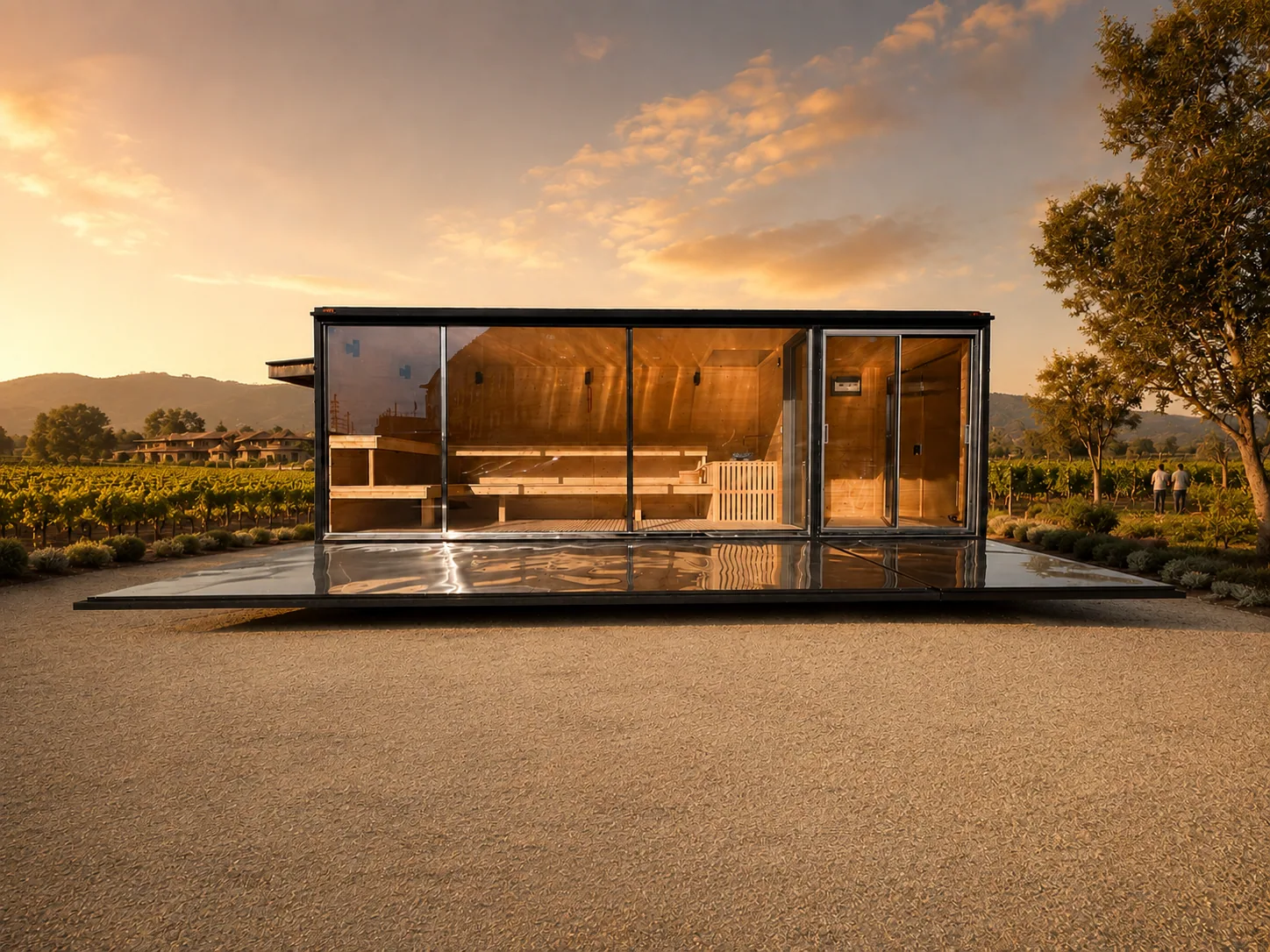
A holiday park or glamping venue should test a mobile sauna as a complete guest experience, not as a stand-alone amenity. Validate demand, choose a suitable guest segment, map the booking and arrival journey, confirm site access and utilities, assess privacy and accessibility, define supervision and cleaning, identify approvals and insurance needs, and model the pilot with conservative assumptions before committing.
A sauna can complement nature accommodation, but a visually attractive concept does not prove commercial or operational fit. Guests may value a private add-on, a shared sunset session or a packaged recovery experience, yet each model creates different staffing, cleaning, access and capacity requirements.
This guide supports an early feasibility discussion. It does not replace planning, building, electrical, plumbing, fire, accessibility, workplace-safety, public-health, legal, insurance or financial advice.
Define the guest problem
Start with the guest segment rather than the equipment. Is the venue serving couples, families, touring groups, retreat guests, corporate groups, athletes or local day visitors? What part of their stay might a sauna improve: rainy-day activity, evening ritual, recovery after outdoor activity, premium package or shoulder-season experience?
The Australian Government’s market-research guidance recommends researching customers, competitors, demand, location and willingness to pay. Use interviews, post-stay surveys, booking data and small tests. Do not rely only on social engagement.
Choose a service model
Describe one operating concept clearly:
- private sessions attached to an accommodation booking;
- shared timed sessions;
- staff-supervised group sessions;
- retreat or event packages;
- a separate day-visitor product;
- seasonal relocation between precincts.
Record booking length, changeover time, cleaning, staffing, late arrivals, weather cancellations, children or companion policies, cooling and hydration, and how guests receive operating information. These are assumptions to test, not universal recommendations.
Map the complete guest journey
Walk from discovery to departure. A guest should understand what the experience is, who it suits, where to go, what to bring, how to change, what supervision applies and how to ask for assistance.
At the site, review reception handoff, pathways, lighting, privacy, changing, toilets, cool-down space, drinking water, weather shelter, staff sightlines and emergency access. Check the journey at night and in poor weather, not only on a sunny inspection.
Tourism Australia’s accessible tourism information encourages operators to assess accessibility and provide accurate visitor information. Publish specific access facts and service alternatives; do not claim that an experience is accessible to everyone without evidence.
Test the site before selecting the format
Prepare a measured site pack covering approach route, turning area, surface, slope, drainage, vegetation, nearby accommodation, guest traffic, utilities, property boundaries and emergency access. Identify noise, steam, lighting and privacy interactions with neighbouring sites.
Confirm legal site control, landlord conditions and advice from the relevant authority. A mobile or trailer-based format does not automatically avoid planning, building or operating requirements. Use the commercial site-requirements guide for the initial question set.
Review utilities and servicing
Ask the supplier and qualified trades for approved electrical requirements and connection arrangements. If water, drainage or wastewater systems are involved, define supply, collection, discharge and maintenance responsibilities. Confirm how cleaning materials, linen, consumables and waste move through the guest precinct.
Avoid routing service staff or equipment through private accommodation zones where possible. Include after-hours isolation, fault reporting and secure access.
Build an operating responsibility matrix
Allocate ownership for bookings, guest information, opening checks, supervision, cleaning, incident response, maintenance, fault escalation, utility isolation, contractor access and closing. Identify who has authority to remove the service from sale.
Safe Work Australia’s model code for managing risks of plant addresses the equipment lifecycle, including installation, operation, inspection, maintenance, transport and storage. Commercial planning should cover more than guest-facing sessions.
Assess capacity honestly
Capacity is not simply the number of seats. The booking model must allow for arrival, explanation, changing, sauna use, cool-down, cleaning and reset. A group that fits physically may not fit the venue’s privacy, supervision or changeover model.
Use approved product documentation for occupancy and operating limits. Then run a timed tabletop exercise and, where appropriate, a controlled pilot. Record actual turnaround, staff minutes, guest questions, faults and no-shows.
Model the pilot
Build a conservative pilot model using visible assumptions:
- saleable sessions by day and season;
- average paid guests per session;
- realised price after packages or discounts;
- cleaning, staffing and consumable cost;
- utilities and maintenance allowance;
- booking fees, insurance and site costs;
- downtime and weather disruption;
- initial works and relocation costs;
- cancellation and refund behaviour;
- a stop, revise or expand gate.
Do not publish forecast revenue as a result. The feasibility and ROI guide explains how to separate assumptions from verified outcomes.
Protect the accommodation experience
Consider whether the proposed location changes views, quiet enjoyment, circulation or privacy for existing guests. Plan session arrivals so they do not conflict with check-in peaks, housekeeping routes or vehicle movements.
Guest communication should avoid unsupported health promises. Describe the service accurately, publish participation information approved by appropriate advisers, and give staff an escalation path for questions they are not qualified to answer.
Plan approval and evidence gates
Before purchase or launch, document the required evidence: site advice, drawings, approved specifications, utility design, certificates or licences where applicable, insurance acceptance, operating procedures, cleaning plan, maintenance schedule, emergency information, accessibility review and staff training.
The supplier should identify assumptions and exclusions. The venue should verify which obligations remain with the owner, operator, landlord, contractor or authority.
Measure what the venue learns
Track enquiries, booking conversion, attendance, paid occupancy, cancellations, turnaround, staff time, faults, complaints, accessibility requests, guest feedback and repeat purchase. Avoid collecting unnecessary sensitive information. Record the source and date of every figure.
A pilot should answer a decision question. Examples include whether the experience fits a premium accommodation package, whether a shared model can be operated within current staffing, or whether demand continues outside peak weekends.
Common feasibility mistakes
- Selecting a site for views before checking access, services and privacy.
- Treating every guest as the target customer.
- Forecasting full sessions without accounting for changeover and cancellations.
- Assuming mobility removes approval obligations.
- Forgetting nighttime lighting, weather and quiet-hours impacts.
- Publishing accessibility or wellness claims without evidence.
- Omitting cleaning, maintenance and fault-response labour.
- Running a pilot without a documented decision gate.
A responsible next step
Create a two-page concept brief with guest segment, service model, site pack, journey map, operating roles, evidence gaps and pilot measures. Invite supplier and professional input against that same document. Proceed only when the venue understands what is included, what remains uncertain and who owns each next action.
Frequently asked questions
Is a mobile sauna suitable for every holiday park?
No. Suitability depends on guests, site access, utilities, privacy, operations, approvals, insurance and the venue’s ability to manage the complete experience.
Should sessions be private or shared?
Test the model against the target guest, staffing, pricing, privacy and capacity. There is no universal best format.
Does a trailer avoid local approvals?
Do not assume so. Seek site-specific advice from the relevant local authority and competent professionals.
How should demand be tested?
Use existing guest data, interviews, surveys, expressions of interest and a controlled pilot where appropriate. Separate stated interest from paid behaviour.
What accessibility information should be published?
Describe actual paths, gradients, steps, doorways, changing options, assistance and service alternatives using verified facts.
How can we discuss a venue concept?
Share the venue, guest segment, proposed site and operating idea through the commercial enquiry form or call 0432 394 901.
Sources and limitations
- Australian Government — Do market research
- Tourism Australia — Accessible tourism
- Safe Work Australia — Managing risks of plant in the workplace
This is general planning information, not legal, approval, engineering, accessibility, safety, financial, medical or insurance advice.
Plan your commercial system
Start with your venue, audience and operating goal.
Tell Mobile Sauna Systems about the proposed site and commercial opportunity so the right questions can be framed for a qualified project discussion.
This article provides general information only and is not medical, legal, planning, engineering or financial advice. Requirements vary by project and jurisdiction. Seek appropriately qualified advice for your circumstances.