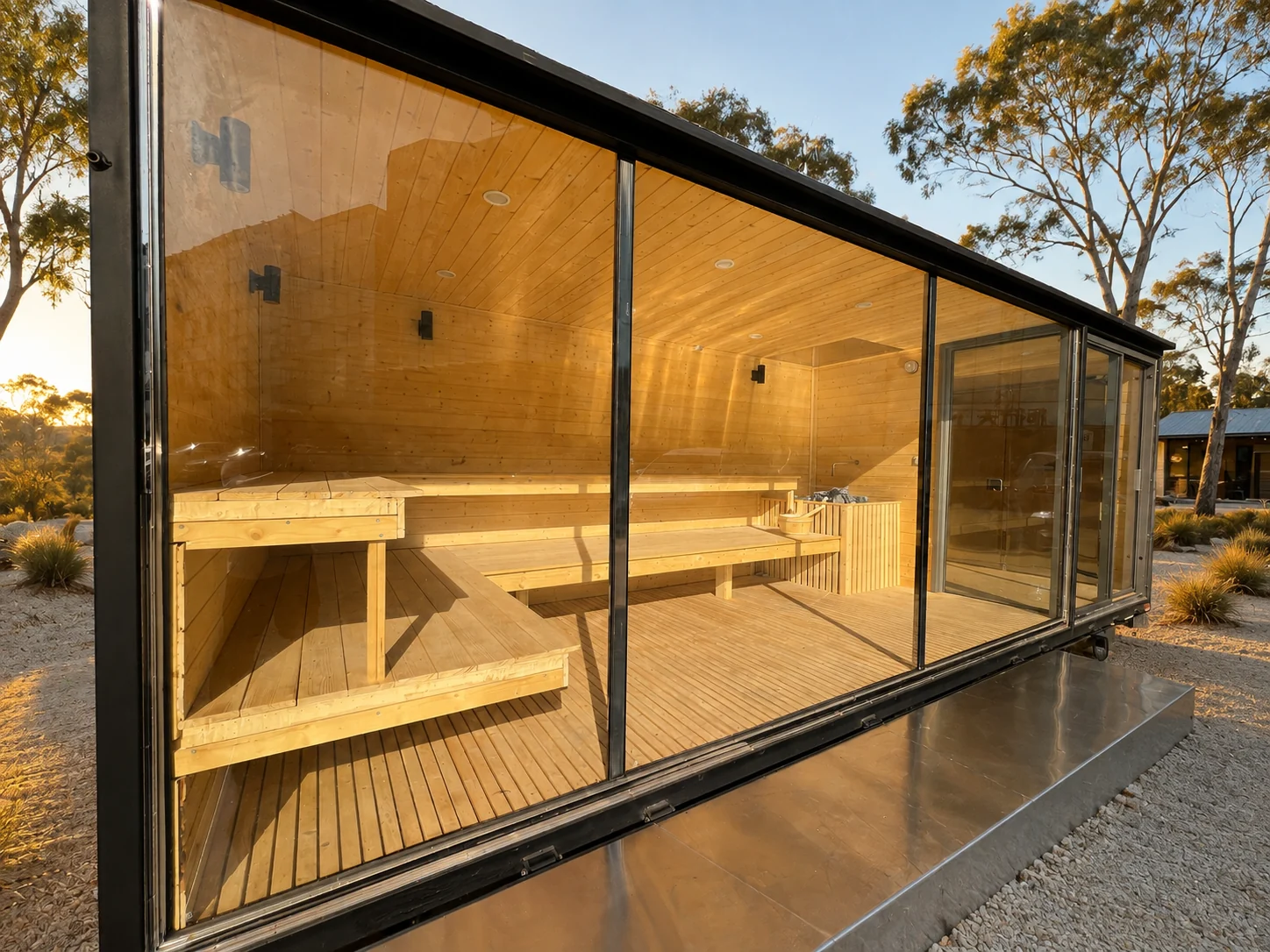
Sauna, cold plunge and red light are not interchangeable add-ons. They create different guest journeys, service demands, supervision needs and evidence obligations. A gym should choose a recovery-area mix from the member problem it wants to solve, the site and staff capacity, and the claims it can responsibly support. Start with one well-run experience, define operating rules and measurement, and add another modality only when the combined journey is safer, clearer and commercially stronger.
Recovery spaces are becoming a visible part of gym and sports-facility offers, but a row of equipment does not automatically create a coherent service. The business has to decide who may use each element, when, under what supervision, how it is cleaned and reset, and what staff will say about it.
This guide compares commercial planning considerations. It does not give medical advice, prescribe recovery protocols or claim that a particular modality treats a condition. Scientific evidence depends on the population, timing, exposure, outcome and equipment studied. Obtain qualified advice for health screening, sport programming, electrical, water treatment, workplace and site requirements.
For a broader project comparison, see the commercial mobile sauna buyer’s guide and total-cost planning framework.
Define the member job first
“Recovery” can mean different things: a quiet decompression ritual after training, a premium social experience, a supervised high-performance session, a wellness membership benefit or a bookable service that brings non-members to the venue. Choose one primary job and one secondary job. Trying to serve every interpretation usually creates confusing rules and weak measurement.
Write down the target users, busiest arrival pattern, session length, supervision model, change facilities, booking method and desired commercial outcome. A sports organisation working around team training has different peaks and duty-of-care questions from a 24-hour gym selling self-directed access.
Also decide what the facility will not claim. Marketing language such as “supports a structured post-training routine” is different from promising injury prevention, treatment, detoxification or guaranteed performance gains. The Therapeutic Goods Administration says therapeutic-goods advertising must be accurate, balanced, not misleading and substantiated. Even where a service or item is outside a particular regulatory category, those principles are a sound factual gate.
Compare the modalities as operating systems
Sauna
A sauna creates a warm, enclosed experience with a strong ritual and social dimension. Commercial planning includes heat source, electrical demand, warm-up and shutdown procedures, bench and floor cleaning, ventilation, guest capacity, door and egress, supervision, hydration messaging and heat-exposure rules.
A relocatable format can separate the recovery experience from the main gym floor and may reduce disruption to an existing building. It still needs a suitable site, safe access, service connections and an approval assessment. It is not automatically exempt because it can be moved.
Sauna may suit a venue seeking a bookable group experience, a premium membership feature or a destination element visible from outside the training space. It can be a weak fit when there is no controlled access, no staff ownership, insufficient power, poor changeover discipline or marketing relies on unsupported health promises.
Cold plunge
A cold plunge creates a short, high-salience experience and can work individually or in a supervised sequence. Operationally it introduces water quality, filtration or replacement, temperature control, wet-area drainage, slip risk, cleaning, entry and exit, water testing, bather load and emergency-response questions.
The Australian Institute of Sport operates hydrotherapy facilities using hot, neutral and cold water as part of a multidisciplinary high-performance environment. That example shows that cold water can sit inside a broader recovery system; it does not establish a universal protocol for every gym member. The AIS Recovery Centre is purpose-designed and professionally managed, so a retail gym should not copy a temperature or sequence without its own qualified assessment.
Cold plunge may suit a supervised premium recovery service or a facility able to manage wet-area operations. It may be a poor first choice where drainage, change areas, water-management competence, accessibility or staff coverage are unresolved.
Red light
“Red light” can refer to products with different wavelengths, outputs, intended purposes and regulatory status. From an operating perspective, the venue needs to understand the actual equipment, electrical demand, eye-safety instructions, cleaning, session control, manufacturer directions, privacy and the evidence permitted for public claims.
Do not treat the category name as proof of a therapeutic effect. If equipment is represented as a medical device or promoted with therapeutic claims, check its Australian Register of Therapeutic Goods status, intended purpose and the advertising rules that apply. Request the specific product documentation rather than accepting generic evidence about light exposure.
Red light can offer a dry, lower-changeover format where the equipment and claims are well controlled. It may be unsuitable when the venue cannot verify the product, train staff or prevent members from extending sessions outside the documented instructions.
Use a commercial comparison matrix
Score each option against the same categories from one to five, with written evidence beside every score:
- fit with the defined member job;
- usable capacity per hour;
- staff supervision and training load;
- electrical and other site services;
- water, drainage and wet-area implications;
- cleaning and reset time;
- member changing, privacy and storage needs;
- accessibility objectives and safe entry or exit;
- emergency and incident response;
- verified equipment documentation;
- claims and marketing evidence;
- maintenance capability and downtime plan;
- booking, access-control and waiver process; and
- contribution to the intended membership or service model.
Weight the categories before scoring. A 24-hour unsupervised gym should weight access control, instructions and emergency response more heavily than visual novelty. A professional sports program may weight staff capability, scheduling and protocol governance more heavily.
Do not let an attractive equipment price dominate the result. The service is the complete operating system, including space, staff, utilities, cleaning, downtime and risk controls.
Decide whether modalities should be combined
Combining sauna and cold plunge can create a distinctive contrast experience, but it also multiplies transitions. Map every step: booking, arrival, health information, changing, showering where applicable, warm exposure, exit, travel across the site, plunge entry, drying, rest and departure.
Ask whether the sequence increases congestion, slippery travel, unsupervised behaviour or misunderstanding. If guests can choose their own sequence and duration, the instructions and monitoring model must reflect that. Do not market a single “best” protocol unless it is supported for the actual users and outcome.
Red light may operate as a separate scheduled service rather than part of a wet-hot circuit. This can protect throughput and simplify cleaning. The right arrangement may be a menu rather than a mandatory sequence.
Run a tabletop simulation at peak time. Include late arrivals, a member who feels unwell, a cleaning delay, a temperature fault, a wet floor and a staff handover. If the team cannot explain who takes control, the combined system is not operationally ready.
Design the supervision model
Choose deliberately between fully supervised sessions, staffed check-in with periodic observation, controlled self-service or another documented model. Base the decision on risk, venue hours, user group, equipment instructions, insurance and qualified advice—not on the staffing level you happen to have today.
The operating file should define eligibility and escalation, maximum occupancy, session control, pre-use information, prohibited conduct, cleaning, daily inspections, fault isolation, first aid, emergency contact and incident recording. Train staff on what they may say about health and performance. A friendly conversation can become an unsupported promise if the team improvises.
Safe Work Australia’s risk-management model code provides the useful cycle of identifying hazards, assessing risks where necessary, controlling them and reviewing the controls. Confirm the applicable Western Australian duties and regulator guidance for the particular operation.
Plan the space around people
Draw the full recovery area, not just the equipment footprint. Include accessible routes, doors, steps or ramps, handholds, non-slip surfaces, drainage, lighting, ventilation, towel and robe handling, drinking water, seating, change facilities, privacy screening, staff sightlines, waiting space and an emergency path.
Separate dry and wet traffic where practical. Keep electrical equipment and connections within the design and installation controls specified by qualified professionals. Plan where a user can sit safely after an exposure and how staff can reach them without crossing a queue.
For a relocatable sauna, include delivery access, stable placement, weather exposure and the path between the unit and the gym. Read the site requirements guide before treating an external pad as ready.
Pilot before a permanent expansion
A pilot should test a defined service, not offer uncontrolled access and hope for insight. Set a limited period, operating hours, target member group, price or inclusion rule, staff roster and capacity. Record problems and changes. Keep the marketing factual and state that the offer is a pilot where appropriate.
Track:
- eligible bookings and show rate;
- sessions delivered and usable capacity;
- repeat use without implying a health outcome;
- incremental staff and cleaning time;
- energy, water and consumable costs;
- reset delays and downtime;
- incidents, near misses and rule breaches;
- member questions and misunderstandings;
- conversion to the relevant membership or service; and
- satisfaction with access, instructions, cleanliness and privacy.
Use a conservative denominator. If the pilot was only open for 40 supervised hours, do not present results as if every gym member had equal access.
Common planning mistakes
- Buying a modality before defining the member job and supervision model.
- Copying elite-sport facilities or social-media protocols into a general gym without qualified review.
- Treating a sauna, plunge and light device as one undifferentiated “recovery” product.
- Ignoring transition areas, wet paths, change rooms and peak-time queues.
- Making broad medical or performance claims that are not supported for the actual equipment and users.
- Underestimating cleaning, water management, staff training and downtime.
- Selling unlimited access when safe capacity and monitoring are limited.
- Measuring likes or curiosity rather than bookings, repeat use, contribution and operating quality.
Make the decision in stages
First approve the service concept. Next confirm site feasibility and regulatory pathways. Then compare verified equipment or system proposals. Build the risk, training and maintenance documents before launch. Pilot the service and review evidence before adding another modality.
Mobile Sauna Systems can help frame a relocatable sauna or recovery-pavilion discussion for gyms and sports organisations. Final specifications, site decisions, protocols and approvals must be confirmed for the project with the appropriate qualified parties.
Frequently asked questions
Which is best for a gym: sauna, cold plunge or red light?
There is no universal best option. The strongest choice fits the defined member service, site services, supervision capacity, cleaning capability, evidence standard and commercial model. Score each option against the same weighted criteria.
Should a gym combine sauna and cold plunge?
Only when the complete guest journey, transitions, water and slip controls, instructions, supervision and evidence are stronger as a combined service. A staged or separate offer may be easier to operate safely and measure accurately.
Can we advertise recovery or performance benefits?
Marketing should be accurate, specific and substantiated for the actual service and equipment. Avoid guaranteed, medical or universal outcomes. Obtain appropriate regulatory and professional advice, especially where therapeutic goods or medical-device claims may be involved.
What should a recovery-area pilot measure?
Measure bookings, show rate, capacity, repeat use, staff and cleaning time, utilities, downtime, incidents, member understanding and commercial contribution. Do not turn a short or selective pilot into a broad health claim.
Can a relocatable sauna sit outside an existing gym?
Potentially, but the site needs verified access, stable placement, services, safe paths, weather planning and project-specific authority, insurer and professional checks. Relocatable does not automatically mean approval-free.
Sources and further checks
Plan your commercial system
Start with your venue, audience and operating goal.
Tell Mobile Sauna Systems about the proposed site and commercial opportunity so the right questions can be framed for a qualified project discussion.
This article provides general information only and is not medical, legal, planning, engineering or financial advice. Requirements vary by project and jurisdiction. Seek appropriately qualified advice for your circumstances.